
Planning commission recommends approval for full‑block downtown mixed‑use redevelopment
Get AI-powered insights, summaries, and transcripts
Sign Up Free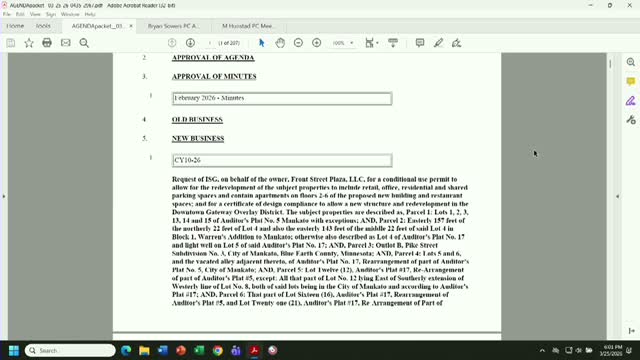
Summary
The Mankato Planning Commission unanimously recommended approval of CY10‑26, a conditional use permit and certificate of design compliance for a full‑block mixed‑use redevelopment on South Front Street that would add roughly 160 apartments, retail and a shared parking ramp; council consideration is scheduled for April 13.
The Mankato Planning Commission voted unanimously to recommend approval of CY10‑26, a conditional use permit and certificate of design compliance that would replace the block bounded by South Riverfront Drive, Warren Street, South Front Street and West Liberty Street with a multistory mixed‑use development including retail, office space, a restaurant and approximately 160 apartments, plus a shared parking ramp. The commission set city council review for April 13.
Staff planning presenter Bennett Hansen told the commission the applicant (ISG on behalf of Front Street Plaza LLC) proposes demolition of all existing structures on the block and construction of two primary buildings — a five‑story office building and a six‑story mixed‑use building — along with a three‑story parking ramp. Hansen said the project would be built in two construction phases and that city approval would include conditions requiring a traffic study, encroachment permits, replacement of boulevard trees at a 2:1 ratio and withholding occupancy until required parking is completed. “The traffic study will be provided prior to city council approval of the final plat,” Hansen said during his presentation.
The applicant emphasized downtown revitalization. An applicant representative described the project as a next phase of downtown redevelopment, linking the design to a regional planning effort and the city’s recent change in parking policy that enabled higher multifamily density. “Phase 2, for us … is density,” the applicant representative said, adding the project mixes retail with 160 units to support walkability and downtown retail demand. ISG architect Jeremy Wiesen outlined design choices intended to preserve pedestrian‑scale qualities at street level while introducing contemporary materials higher on the facades.
Public comment reflected both support and concern. Former building owner Bennett Coughlin said he supported the redevelopment as a way to bring residents and customers back downtown: “This project … is not about erasing history, it’s about continuing it.” Local business owners raised parking and construction concerns. Mark Houston said he relied on the Walgreens lot for customer parking and worried about long‑term parking access and whether tax‑increment financing would obligate public parking to remain available. A downtown building owner said a grocery anchor would be important and reiterated concerns about safety and parking competition. Rob Foster, whose business faces the site, urged stronger protections for businesses during construction, citing noise, dust and subcontractor parking in prior projects.
Staff findings and recommended conditions listed in the record include: submission of a detailed traffic study coordinated with the city engineer; monitoring and potential modification of traffic movements at adjacent intersections; applications and permits for encroachments into the right of way; a required pre‑construction meeting with the neighborhood at least 30 days before work begins; separate meters and connection fees per city assessment policy; a requirement that occupancy of phase 1 not occur until phase 2 parking is completed; replacement of removed boulevard trees at a 2:1 ratio; and that signage and murals require separate approvals. Hansen also noted the applicant reported the proposed project value exceeds $500,000.
Commission members debated architectural compatibility with neighboring historic buildings and how parking demand would be measured and managed. Staff said parking demand would be measured with a parking study and modern counting technologies and noted the project’s ramp footings allow future expansion if needed. The commission approved a motion to recommend the conditional use permit and design compliance, with the item advanced to city council for a final decision on April 13.
Next steps: city council review on April 13; staff will require the traffic study and other conditions outlined before council final action.