Get Full Government Meeting Transcripts, Videos, & Alerts Forever!
Get email alerts on the Community Safety topic
No spam. Unsubscribe anytime.
Mankato council hears pleas over ICE activity, approves $30,000 in food grants and asks staff to draft emergency law-enforcement ordinance
Summary
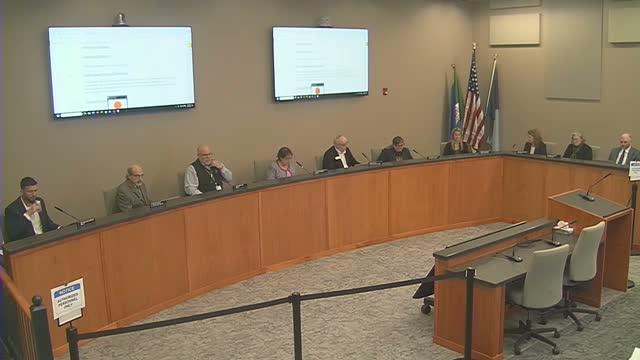
After multiple public commenters urged the council to act on recent ICE activity and to form a human-rights advisory committee, the Mankato City Council voted to allocate $30,000 to local food providers and directed staff to prepare an emergency ordinance on law-enforcement identification and camera rules.
Dozens of residents urged the Mankato City Council to act on recent immigration-enforcement activity and to form a human-rights advisory committee during lengthy public comment on Feb. 23.
Wyatt Buren told the council that local and national enforcement actions were harming people and urged continued pressure on federal agents, saying, "Pressure against ice is working." Jacob Basis, who said he had helped organize protests and been asked to serve on a human-rights advisory committee, told the council the community needed "plain honesty" and that officials should "act in a way that bolsters public trust in our institutions." Humanities professor Jamil Huck described a recent Target protest where officers ordered attendees to leave and urged the council to "move forward" with a human-rights commission.
Randy Dinsmore, who said he represents Pact Ministries and operates a neighborhood thrift store that funds food distributions, told council members that preliminary assessment and parking-lot paving costs tied to a Range Street improvement could be a severe financial hit. "Between those two things, paving the parking lot and the assessment you guys are asking, we're at about 5,500 families that aren't gonna see a basket of food," Dinsmore said, asking staff and council for relief or assistance.
City Manager Arns acknowledged the ministry's reported impact and said staff had not previously been aware of the scale of the effect. "This is the first I've heard of this impact," Arns said, and pledged further discussion to identify options before any final assessment decisions.
Following public comment and staff reports, council members voted to use undesignated fund balance to make one-time grants of $10,000 each to three local food organizations identified in staff materials: ECHO Food Shelf, Southern Minnesota Food Recovery Program and Feeding Our Community Partners (total $30,000). The council approved the motion by voice vote.
Council and staff also discussed a draft ordinance that would require law-enforcement officers operating in the city to identify themselves (including unit or agency), address mask use in enforcement activity and consider body-worn-camera requirements. City Manager Arns said staff would prepare language for an emergency ordinance to shorten the adoption timeline, while also flagging enforceability and mutual-aid complications with agencies that do not have body cameras. Interim public-safety leadership said federal agents had twice notified the city and provided an agent-in-charge contact in recent operations, but city legal counsel had advised that some operational details could not be publicly released.
Council members agreed to move quickly on drafting the ordinance and to set a public hearing once language is ready. They also asked staff to continue working with organizations affected by the planned street improvements to explore mitigation before assessments are finalized.
The council's next regular meeting dates were discussed as part of scheduling for the ordinance process; staff said publication and hearing timelines meant any emergency ordinance would likely be considered in March.