Get Full Government Meeting Transcripts, Videos, & Alerts Forever!
Get email alerts on the Emergency Ordinance topic
No spam. Unsubscribe anytime.
Mankato council adopts emergency ordinance requiring local identification and body‑camera use for law‑enforcement actions
Summary
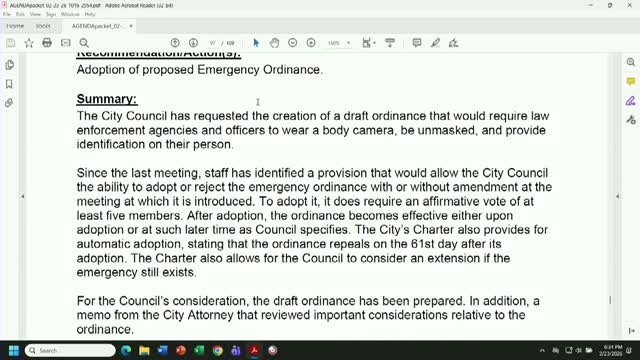
The Mankato City Council voted to adopt an emergency ordinance clarifying local requirements for law‑enforcement identification, body cameras and notice to the city; staff said the measure could take effect immediately and expire after 60 days unless extended.
Mankato’s City Council voted to adopt an emergency ordinance intended to clarify when officers working in the city must identify themselves, use available body cameras and provide notice to city staff.
City Attorney Pam Whitmore told the council the measure draws on the city’s police powers and the charter’s emergency‑ordinance provisions (charter section 2.15) to allow immediate effect; she also cited state law related to anti‑masking (the memo referenced statute 609.755) and warned the council about preemption limits and ongoing litigation in other jurisdictions.
The ordinance, advanced as an emergency measure by Councilmember McLaughlin and seconded by Councilmember Mettler, was adopted in a roll‑call process in which the clerk recorded affirmative votes and the mayor declared the motion passed. Under the draft language staff reviewed, an adopted emergency ordinance would expire on the 61st day after adoption unless the council votes to extend it.
Why it matters: supporters and some city officials said the ordinance is intended to increase transparency when people exercising law‑enforcement powers operate in Mankato, particularly amid concerns raised by residents and activists about federal immigration enforcement activity. Opponents and some councilmembers cautioned that the ordinance could be difficult to enforce, might prompt federal scrutiny or funding threats, and requires careful definition of terms such as “law‑enforcement activity” and “facial covering.”
City Manager Arnds recommended adopting the ordinance as an emergency measure to allow staff to test it in practice, notify partner agencies and return with early implementation feedback. Whitmore and Director Clifton said the ordinance exempts undercover operations from identification requirements and that, in practice, enforcement would most commonly result in misdemeanor citations where the ordinance does not conflict with federal duties. Whitmore said the office had reviewed other cities’ approaches and noted mixed litigation results elsewhere.
Several councilmembers pressed staff on enforcement details. One asked whether the city could cite federal officers who refused to identify themselves; Whitmore said the city could issue a misdemeanor citation if the conduct violated local code and was not preempted, but enforcement would be challenging and dependent on facts at the scene. Director Clifton said staff would need training to respond to situations the ordinance might create and recommended publishing the ordinance and sending copies to routine partner agencies for awareness.
The council directed staff to publish the ordinance, notify partner agencies, and return with an update on how it is working if the council keeps the emergency measure in effect. The ordinance’s temporary status means the council can revisit language and consider a permanent code change if it chooses.
Quotes: Whitmore said having the emergency option “allows you to adopt this right away” under the charter, while Director Clifton said the intention was sound and emphasized the need for staff training and clarity on implementation.
Next steps: staff said the ordinance would be sent for publication per charter requirements and that council would consider extension or permanent codification at a subsequent meeting before the ordinance’s automatic expiration.