Get Full Government Meeting Transcripts, Videos, & Alerts Forever!
Get email alerts on the Alpr Privacy School Safety topic
No spam. Unsubscribe anytime.
Residents press Mankato council on ALPR cameras, school safety and community supports
Summary
During a public forum the night the council debated legal options, many residents described fear after reported federal activity, urged suspension or stricter controls on ALPR (license‑plate reader) systems, asked for protections for schools and requested funding supports for affected residents.
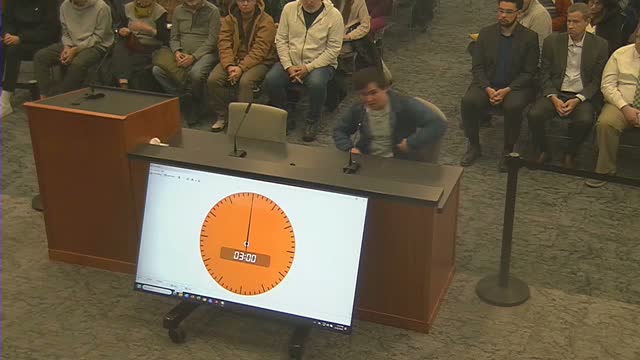
Public commenters at the Jan. 26 Mankato City Council meeting described fear, reports of impersonation and requests for help after multiple incidents they linked to federal enforcement activity in Minnesota. Speakers urged the council to strengthen community supports, examine Automated License Plate Reader (ALPR) use, and protect students and other vulnerable people.
Several speakers pressed staff about ALPR systems and privacy. One commenter told the council the mall area has ALPR installations and argued the cameras create searchable movement databases; others asked whether the city shares data with outside agencies and whether ALPR could be used to alert residents about federal activity. City Manager Arntz and Director Clifton responded that the city has three fixed ALPR locations, has not shared ALPR data to date, and that Minnesota statute 13.824 governs governmental data practices and constrains some uses and disclosures.
On school safety and perimeters, students and parents reported that children were frightened by reports of federal agents near schools and asked whether the city can request buffer zones around schools, hospitals or courthouses. City Attorney Whitmore and staff said school property is under the school district’s authority (not city property) and that the city lacks clear authority to impose buffer distances on agencies beyond the city's property rights; however, staff said they routinely coordinate with school resource officers and can work with school administrators on concerns.
Residents also asked what emergency support the city could provide. City Manager Arntz said the council could direct staff to use undesignated fund balance or public‑safety funds to issue grants to local food shelves or nonprofits (Echo Food Shelf and Southern Minnesota Food Recovery Program were mentioned) but cautioned that federal Community Development Block Grant (CDBG) funds cannot be used in ways that could be construed as supporting enforcement activity.
What residents asked for: amicus briefs, public summaries of litigation, a 'know your rights' resource page (work is underway with the Greater Mankato Diversity Council), closed captioning for meetings, and clear public communication when staff files litigation documents or policy drafts.