Get Full Government Meeting Transcripts, Videos, & Alerts Forever!
Get email alerts on the Ordinance Identification Bodycams topic
No spam. Unsubscribe anytime.
Mankato council asks staff to draft ordinance on identification and body cameras for non‑local law enforcement
Summary
The council directed staff to prepare a draft ordinance exploring requirements that law‑enforcement personnel performing duties in Mankato display clear agency identification, wear body cameras and refrain from masking while operating in the city; staff cautioned about legal limits and will return a draft for review.
The Mankato City Council on Jan. 26 voted to direct staff to draft an ordinance that would explore requiring law‑enforcement personnel conducting law‑enforcement duties inside city limits to display clear identification, wear body‑worn cameras and not wear masks while operating in the city.
Council Member Lavin offered the motion and Council Member Metler seconded it. After council discussion and a minor amendment to include clear visible identification, the motion passed and staff were directed to prepare a draft ordinance for future review and public comment.
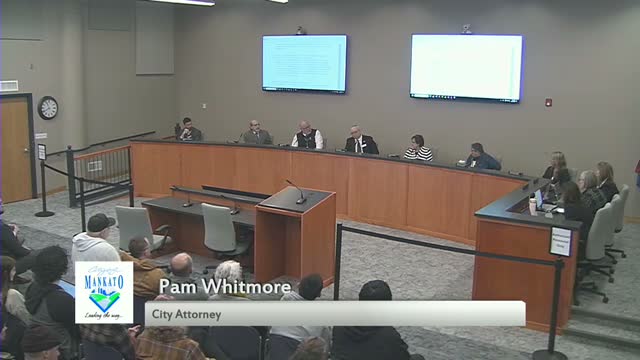
What the draft will examine: City Attorney Whitmore and staff told the council they have a draft from another city to use as a template but cautioned that authority to impose requirements on out‑of‑jurisdiction officers is not settled and that courts may be called upon to resolve scope and enforceability. Whitmore said some cities have proposed ordinances requiring identification, body cameras and prohibiting masks; she emphasized that a court would ultimately determine whether such rules could be applied to federal agents or non‑local officers.
Operational context and examples: City Manager Arntz noted that the ordinance would apply when outside officers are "performing law enforcement duties" inside Mankato and not to non‑operational situations such as conference attendance. The manager also raised practical questions about enforcement and exceptions.
Next steps: Staff will draft the ordinance language, review legal authority and present the draft to the council for public review. The council asked for transparency and a public summary when the draft is returned.