Get Full Government Meeting Transcripts, Videos, & Alerts Forever!
Get email alerts on the Building Inspections topic
No spam. Unsubscribe anytime.
La Crosse inspections chief outlines how orders to correct, condemnations and vacant-property registration work
Summary
City building inspections chief David Reinhardt told commissioners the department issued roughly 3,200 orders to correct annually (nearly 3,600 last year), described condemnation categories and walked the council through the city’s vacant-property registration and fee schedule, enforcement steps and common complaint channels.
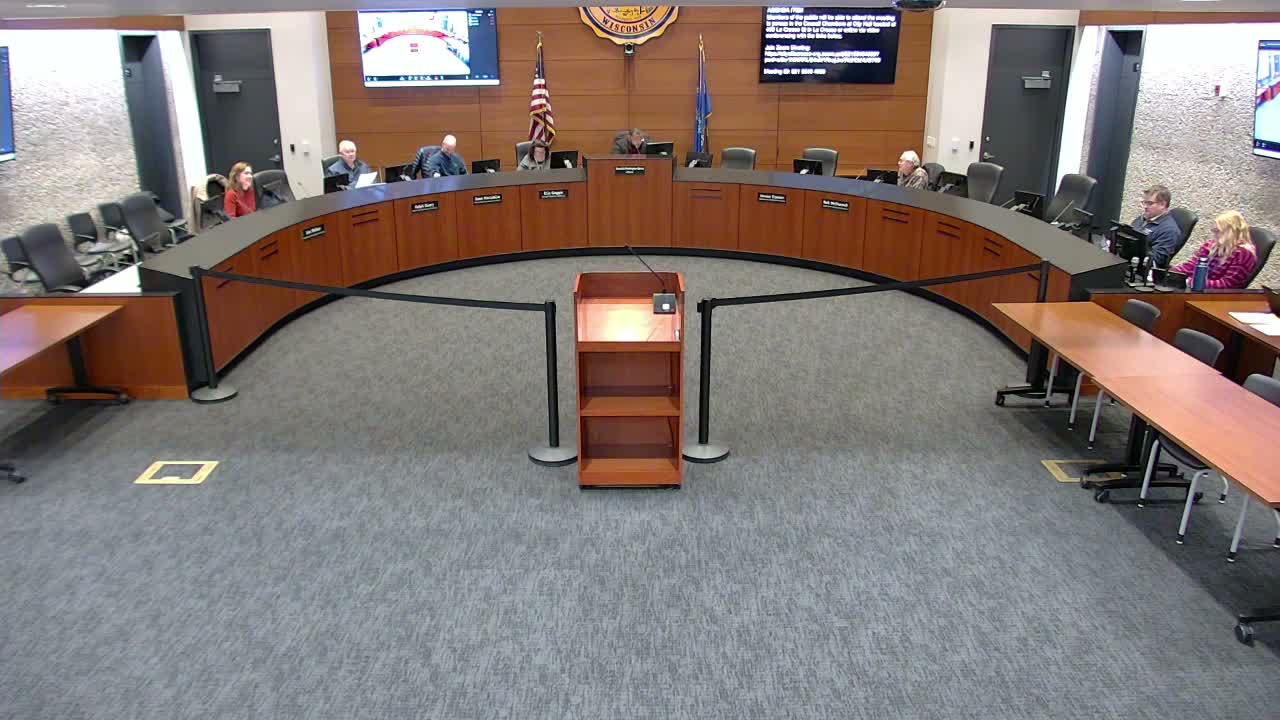
David Reinhardt, the city’s chief building inspector, told the City of La Crosse commissioners on Feb. 4 that his department oversees a range of permits and a multi-tiered enforcement process for property maintenance, condemnations and vacant structures.
“I’m David Reinhardt. I’m the chief building inspector for the city of La Crosse,” Reinhardt said, and then described his staff: four building/HVAC inspectors, electrical and plumbing inspectors, code technicians, enforcement techs, a floodplain/chronic-nuisance technician and an administrative assistant. He said the department is fully staffed.
Reinhardt listed common permit types that require inspection — additions and remodels for single- and two-family homes, commercial work, accessory structures and solar installations — and said the inspections group also issues all sign permits under a robust local sign code. He described the city’s maintenance and inspector districts and noted electrical and plumbing inspectors work citywide.
On enforcement, Reinhardt described the department’s use of an “order to correct” (OTC) for violations such as garbage and outside storage, unregistered vehicles, graffiti, exterior appearance and tall weeds. Inspectors perform reinspections and may grant extensions for valid reasons. “If the owner still chooses not to respond … citations are issued,” he said, and in limited cases the city may do the work and bill the property owner (for example, contractor cleanup for tall grass or weeds).
Reinhardt said the inspections office issues thousands of OTCs annually. “Over the last 10 years, building inspections has averaged issuing over 3,200 orders to correct per year,” he said. Last year the department issued nearly 3,600.
He described three condemnation categories: immediate condemnation for unsafe human habitation (filth/squalor, lack of utilities), rehabilitation or raise-and-repair orders for substantial structural damage, and raise-and-remove/demolition orders when a building is beyond repair.
Reinhardt summarized the vacant-property registration ordinance: structures that are vacant must be registered within 30 days (vacant land is excluded), with exemptions for permitted renovations, seasonal/vacation properties meeting defined occupancy criteria, properties in probate and certain MLS-listed properties. Registration renews every six months; the first registration carries a $50 inspection fee. Reinhardt said subsequent registrations carry higher fees, and properties with open orders to correct may face larger registration fees. He cautioned that repeated noncompliance can generate escalating fees and court citations under the municipal code, which allows fines in a range from $50 to $1,000.
Reinhardt urged residents to file complaints through the city website (Citizen 311), by email or phone, or via the 311 app. He said the department sometimes receives police referrals (for private-property issues such as unlicensed vehicles) and can pursue inspection warrants through municipal court when owners deny interior access.
When asked about long-vacant properties held by banks or resulting from reverse mortgages, Reinhardt said the department directs OTCs to the recorded owner; many banks register and cooperate, but exterior upkeep can mask vacancy so citizen complaints and verification remain important.
Mayor (identified in the record as the meeting chair) and commissioners pressed staff on timing and outcomes: Reinhardt said the department’s policy is to inspect complaints within two business days and that postal delays can slow the formal notice process in some cases. He showed before-and-after photographs to illustrate cases where orders led to compliance.
The meeting included questions about the municipal heating standard (the code requires furnaces to be able to supply 67°F throughout a dwelling), open-records access to vacancy registrations and the department’s neighborhood inspection approach (inspectors typically check a block on each side to avoid singling out a single property).
Next steps: the department continues enforcement under the existing municipal code; commissioners discussed public education steps the mayor is pursuing (a homeowner web page with code links) and encouraged residents to use the city complaint tools so inspections staff can verify and follow up.
Ending: Reinhardt closed his presentation by fielding multiple commissioner questions; no formal policy or ordinance change was adopted at the meeting.