Get Full Government Meeting Transcripts, Videos, & Alerts Forever!
Get email alerts on the Transportation topic
No spam. Unsubscribe anytime.
La Crosse committee recommends keeping downtown parking, backs Alternative 2 for USH‑53 corridor
Summary
After a three-hour public hearing split between business owners and bike advocates, the Judiciary & Administration Committee voted 5–2 to recommend Alternative 2 (parking on both sides, no bike lane) for the USH‑53 corridor; an earlier hybrid proposal failed 3–4.
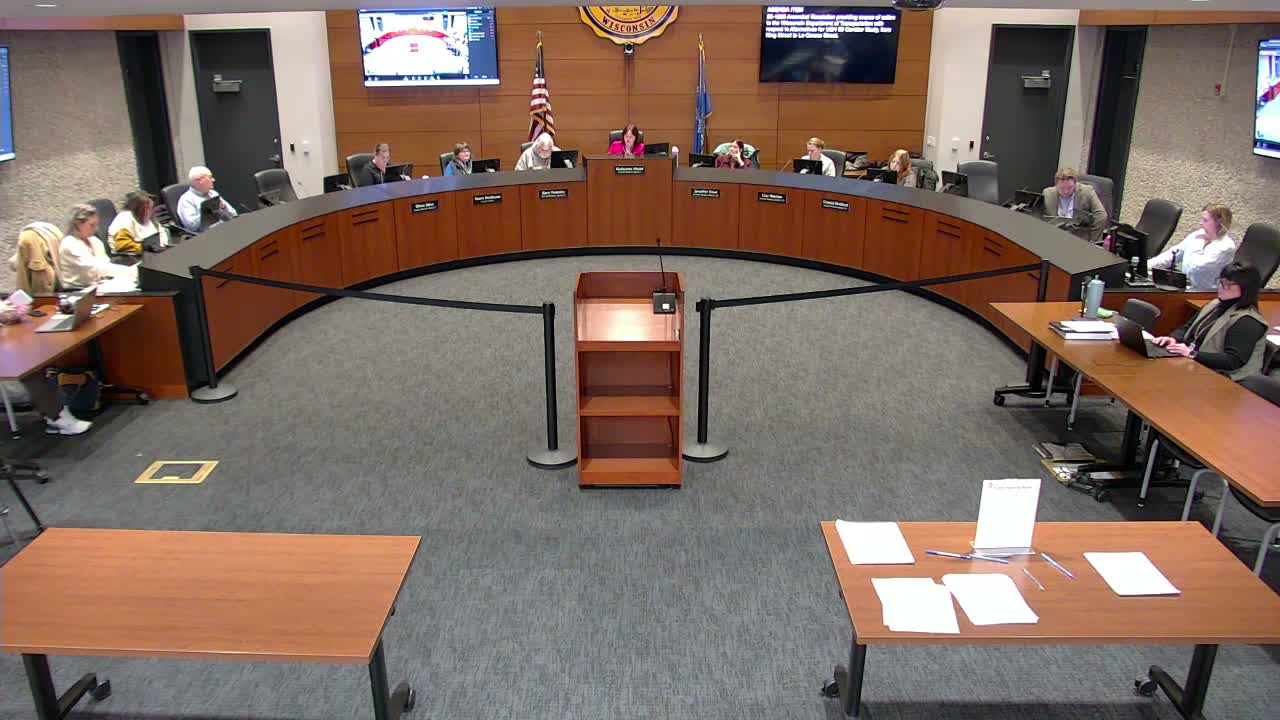
The Judiciary & Administration Committee on Feb. 3 recommended that the full La Crosse City Council adopt Alternative 2 for the USH‑53 corridor study — the option that preserves on‑street parking on both sides of 3rd and 4th streets and does not add a protected bike lane. The committee voted 5–2 after a lengthy public hearing and follow-up motions.
The committee opened a public hearing on the corridor alternatives after city staff and Wisconsin Department of Transportation representatives explained cost‑sharing rules: the state typically pays for travel lanes while the city would fund parking-lane or on‑street facility differences. DOT staff also described the hybrid “Alternative 3” as a mix of options that would maintain parking on some blocks and add sidewalk‑level protected lanes on others.
Dozens of downtown business owners and residents urged the committee to preserve on‑street parking. “The 72 parking spots represent, again, two‑to‑16 opportunities minimum that are being taken away from our small businesses,” said Kelly Goodwin, who identified herself as representing Touch A Class, a longtime downtown business. Property owners and restaurateurs testified that on‑street parking provides quick turnover critical to retail and service customers.
Bicycle and climate advocates countered that protected bike lanes improve safety and support long‑term mobility and climate goals. “Protected bike lanes separate bikes and cars, making travel safer and smoother for everyone,” said Cathy Van Mera, a downtown resident who urged support for Alternative 1 or the DOT hybrid.
Council member Padeschi moved to approve the DOT’s hybrid option (commonly called Alternative 3); DOT staff cautioned that extending the hybrid to State Street would increase parking loss by “about 8 to 10 spaces” on some blocks and that Vine Street was chosen because it already has bike lanes. The hybrid motion failed on a 3–4 vote.
After a successful motion to reconsider the failed hybrid, the committee instead voted to recommend Alternative 2 — maintaining parking on both sides and not adding bike lanes on the affected blocks — by a 5–2 margin. The committee clerk stated the item will appear on the full council agenda next week with that committee recommendation.
What’s next: The full City Council will consider the same resolution and alternatives at its next meeting. DOT representatives said final design and a state‑municipal financial agreement would determine exact cost shares and specific improvements.
Votes at a glance: Motion to approve Alternative 3 (hybrid): failed, 3 yes, 4 no. Motion to reconsider: passed, 6 yes, 1 no. Motion to adopt Alternative 2 (status quo — parking both sides, no bike lane): passed, 5 yes, 2 no.
Reporting note: Quotes and vote tallies are drawn from the Judiciary & Administration Committee transcript of the Feb. 3, 2026 meeting. The committee’s recommendation will be considered by the full council next week.