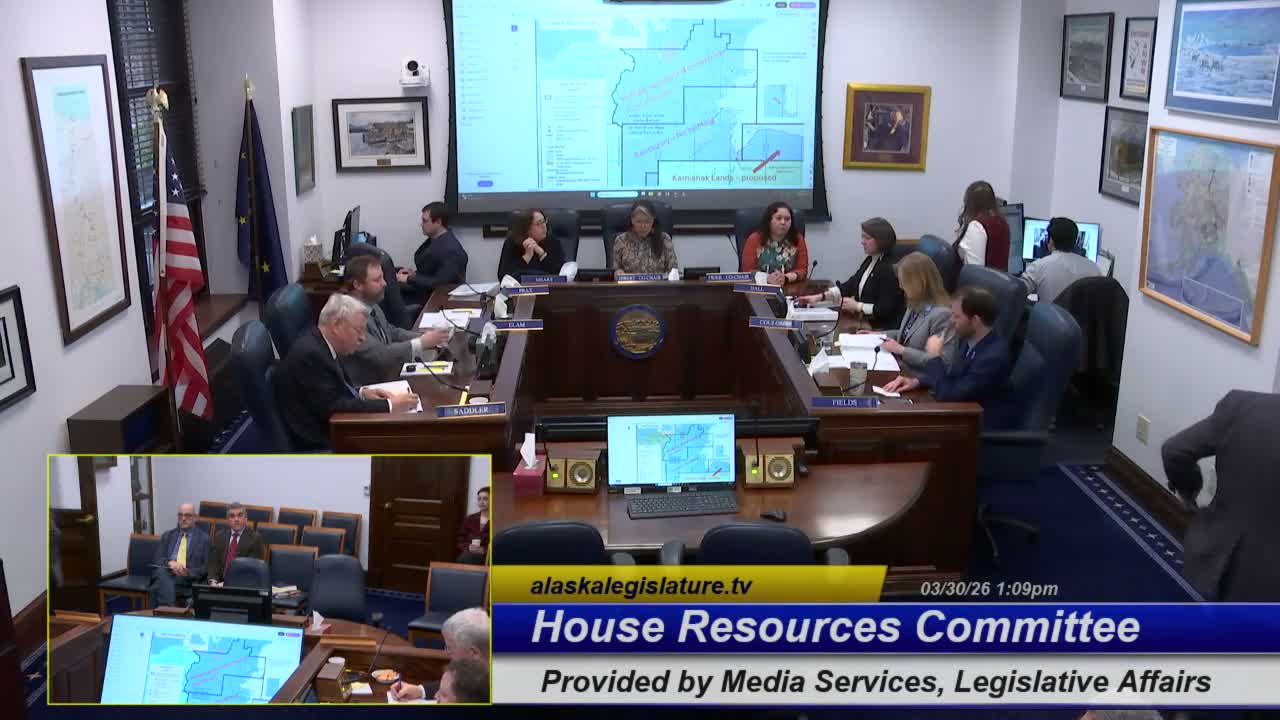
House committee hears testimony on bill to reclassify state wildlife areas and bar personal watercraft in Kachemak Bay
Loading...
Summary
The House Resources Committee heard public and invited testimony on House Bill 3 21, which would standardize state 'special area' names and boundaries, clarify firearms-discharge authority, statutorily close some brown-bear hunting areas, and prohibit personal watercraft in Kachemak Bay; the committee held the bill over and set an amendment deadline.
Juneau — The House Resources Committee on Monday took testimony on House Bill 3 21, a broad rewrite of statutes governing Fish and Game special areas that would consolidate multiple categories (state game refuges, sanctuaries and critical habitat areas) into unified "wildlife refuge" and "wildlife sanctuary" designations, clarify management purposes and boundary errors, and add several parcels to existing refuges.
"The bill's main feature is to take areas currently under fish and game management and treat them as part of either a refuge or a sanctuary since they're being managed in that way anyway," sponsor Representative Andy Josephson said in opening remarks. Josephson said the measure also contains targeted language to let the department adopt regulations to close small areas for public safety (for example around target-shooting access sites) while preserving hunting, fishing and subsistence uses.
Why it matters: Supporters said the measure modernizes inconsistent statutory language, protects habitat, and corrects mapping oversights that left contiguous wetlands or recently acquired parcels outside refuge boundaries. Opponents and some agencies warned the omnibus approach mixes largely noncontroversial boundary fixes with politically sensitive items — notably a proposed prohibition on personal watercraft (PWCs) in Kachemak Bay and provisions related to firearms closures — raising questions about delegation of authority and practical effects on users.
Public commenters who live near Kachemak Bay urged the committee to back the bill and restore a local PWC ban. "The process the administration used to remove the ban was deeply flawed," Nancy Lord of Homer told the committee, saying she believed nonlocal petition signatures were weighted equally with local expertise. Several other Homer-area speakers and local advisory boards also urged restoration of the ban to protect wildlife, tourism and local values.
Agency and legal views: Commissioner Vincent Lang of the Alaska Department of Fish and Game said the department generally supports the bill's boundary corrections and the effort to standardize terminology, but opposed the Kachemak Bay PWC prohibition. "The department is opposed to this provision," Lang told the committee, noting the Alaska Supreme Court had previously addressed aspects of the agency's discretion on jet-ski allowances and estimating nominal sign-update costs of about $45,000.
Lehi Legal attorney Alpheus Bullard cautioned that recent litigation centered on the department's procedural discretion rather than the substantive merits of allowing PWCs. "If the legislature were to elect to prohibit personal watercraft, it would be a different legal question," Bullard said, distinguishing an administrative decision from a statutory prohibition.
Members also focused on the bill's firearms language. The committee substitute clarifies that the department's closure authority is intended to target the discharge of firearms for purposes other than hunting, trapping and fishing — for example, to limit target shooting near access sites for public safety — but several representatives worried the language could be read to allow closures of long‑standing community ranges. Representative Klum and others asked whether Rabbit Creek Rifle Range could be affected; Josephson said he would accept a friendly amendment clarifying that "nothing in this act requires or otherwise allows" closure of the range.
Specific land additions were highlighted by witnesses: John Ross of The Conservation Fund said HB 321 would add 688 acres to Creamers Field Wildlife Refuge (purchased with federal Pittman–Robertson funds and private matches) and that an additional 375‑acre purchase is in process to complete the logical footprint. Multiple speakers from conservation groups and local advisory boards described other parcel additions and boundary corrections across the state.
Process and next steps: Several members urged splitting the omnibus bill so uncontested boundary and cleanup items could pass separately from contentious policy changes; the sponsor said time constraints this session made breaking it into separate bills impractical. The committee held the bill over for another hearing, set an amendment deadline of Monday, April 6 at noon to committee aides Sarah Snowberger and Calvin Zullo, and scheduled the next House Resources meeting for April 1 at 1 p.m.
The committee did not take a formal vote on the bill during the hearing. The record includes a five‑page memo dated March 17 from the sponsor's office that staff said links new maps to bill sections and responds to committee questions.
What supporters said: Multiple Homer‑area speakers, local advisory board chairs and conservation groups said the bill corrects mapping errors, strengthens habitat protections and — in the case of Kachemak Bay — would restore a PWC ban they say is supported by local science and community preference.
What opponents or agencies said: The Alaska Department of Fish and Game expressed concern that combining critical‑habitat purpose language with refuge management could, in some cases, create tension with traditional hunting and fishing uses; the department is opposed to the bill's PWC prohibition. Legal counsel noted the distinction between administrative discretion upheld in court and a direct legislative ban.
The committee hearing closed after staff reviewed the sponsor's memo and maps. The bill will return for further consideration with an amendment deadline of April 6 at noon.