Committee adopts working document on UI bill shifting employee tax allocation and indexing benefit caps
Loading...
Summary
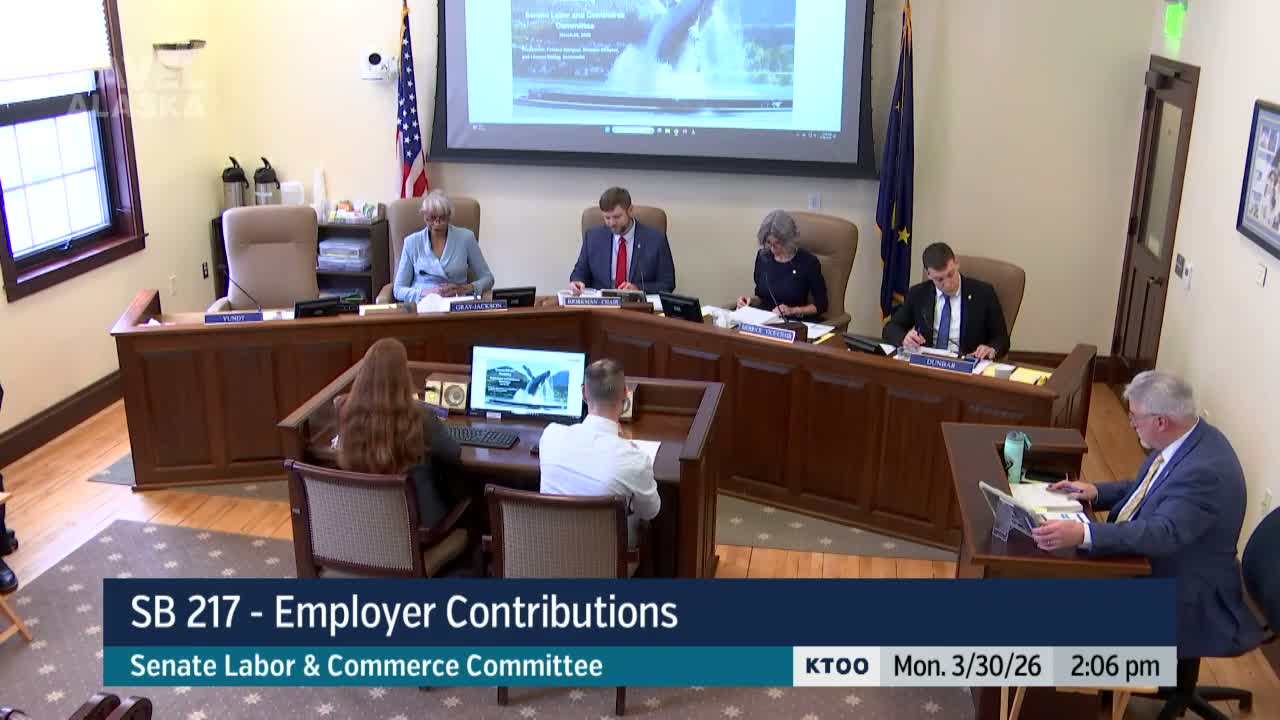
Senate Bill 217 (committee substitute) was taken up for detailed modeling. Department of Labor presenters showed scenarios that change the maximum weekly UI benefit (options include $4.70 or $5.25/week with indexing) and clarify employee versus employer tax allocation; the committee adopted a committee substitute as the working document and set the bill aside for additional work.
The Senate Labor and Commerce Committee on March 30 received an extended briefing on Senate Bill 217 and competing committee substitute language that would change unemployment insurance benefit caps and how employee contributions are allocated.
Paloma Harbor, director of the Division of Employment and Training Services, and Lennon Weller, the department actuary for the unemployment insurance (UI) system, presented four modeled scenarios. Weller explained the statutory mechanics: an average benefit cost rate is apportioned 73% to employers and 27% to employees under current statute, and statutory minimums currently require a 1% employer minimum and a 0.5% employee minimum. The committee substitute (version N) increases the maximum weekly benefit to $525 and indexes it annually; an alternative working draft (version I) begins at $470 with annual indexing.
Weller said the department modeled scenarios showing reserves through 2040 and emphasized the statutory target reserve ratio is roughly 3–3.3% of wages. "If employees are contributing a portion that is actually diverted into training programs rather than the trust fund, the trust fund ends up collecting less than it expects and that creates a timing mismatch in cost recapture," Weller told the committee. The presenters explained that clarifying the statutory language to direct employee contributions expressly to training programs while making employers responsible for UI costs corrects that mismatch.
Committee members asked whether eliminating the employee minimum contribution (a 0.05 percentage‑point statutory minimum referenced in models) would reduce total revenues. Officials replied that total dollars flowing into the fund are a function of how statutory minimums and indexing interact and that the change shifts collection mechanics to the employer side while preserving solvency planning mechanisms through future solvency adjustments.
Senator Delmar moved to adopt the committee substitute (version I as the working document). Director Harbor clarified that version I raises the maximum weekly benefit from the prior $370 to $470 and indexes it to wage growth, while clarifying employee taxes to direct training contributions separately and have employers pay the UI portion. With no further objection, the committee accepted the committee substitute as the working document and set SB 217 aside for future hearings, where staff said additional provisions (including work‑comp items) will be discussed.
The committee did not hold a final vote on the bill; members asked the department to continue refining cost and solvency projections and to return with additional technical detail in a subsequent hearing.