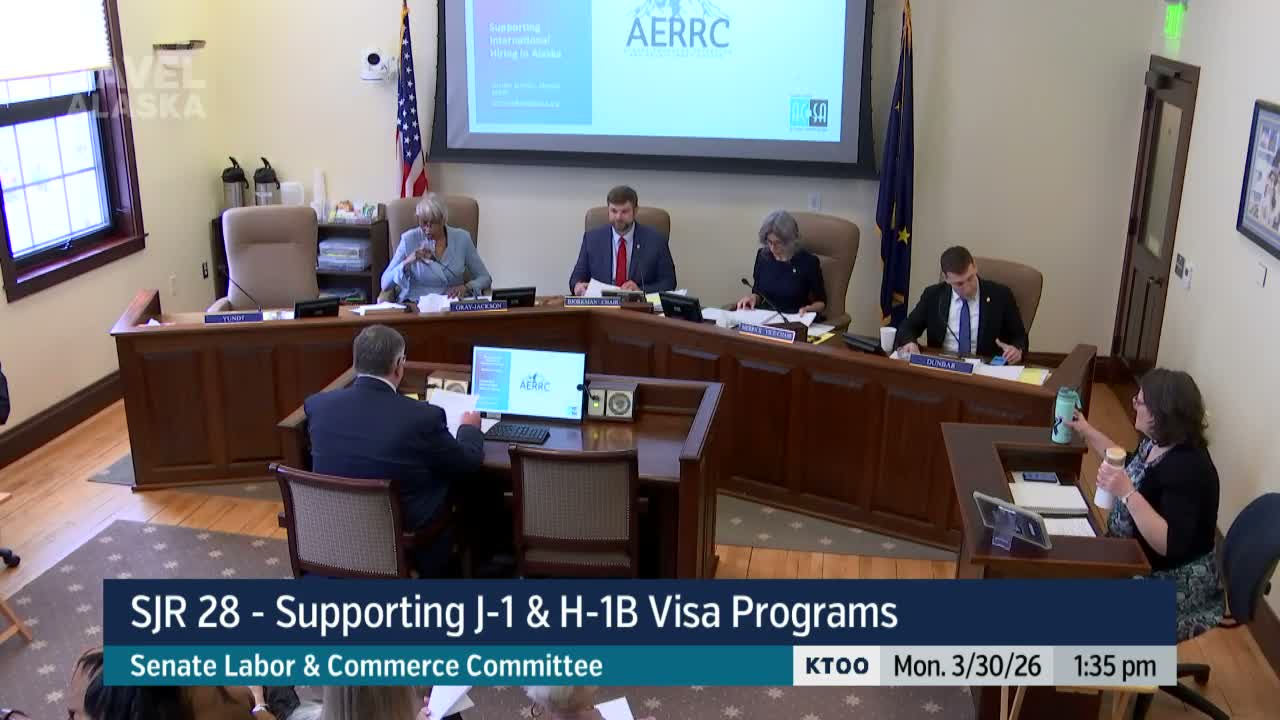
Committee hears testimony backing SJR 28 to support J‑1 and H‑1B visa pathways for Alaska employers and schools
Loading...
Summary
Senate Labor and Commerce heard testimony in favor of SJR 28, a nonbinding resolution urging federal policymakers to preserve J‑1 exchange and H‑1B pathways. Witnesses said a Sept. 2025 proclamation imposing a $100,000 fee on many H‑1B petitions and federal restrictions on J‑1 placements are straining rural schools and seasonal industries.
Chair Senator Bjorkman convened the Senate Labor and Commerce Committee on March 30 and opened the first item, Senate Joint Resolution 28, asking the Legislature to support J‑1 exchange and H‑1B employment visas that, proponents say, are vital to Alaska’s seasonal and rural workforce.
Mike Mason, staff to Senator Luca Tobin, presented the resolution and said the programs are essential for industries that cannot be staffed locally year‑round. "Alaska has the largest seasonal employment swing in the country with a gap of about 43,900 jobs between the lowest and the highest employment months," Mason told the committee and said visitor‑related industries employed about 68,300 workers in 2024. Mason and other witnesses noted a September 2025 presidential proclamation now requires a $100,000 payment for certain H‑1B petitions — a change they said effectively priced many employers out of the program.
The resolution’s invited witnesses described the effect on education in particular. Jennifer Schmitz, director of the Alaska Educator Retention and Recruitment Center, told the committee that Alaska began the school year with 345 unfilled classroom positions and that 573 teachers were working on visas; districts also relied on 285 emergency certificates to staff classrooms. Schmitz said federal guidance has curtailed J‑1 placements in many rural communities, leaving H‑1B the only viable option for off‑road districts — but the new fee makes H‑1B hiring unaffordable for most districts.
Victoria Francis, deputy director of state and local initiatives for the American Immigration Council, said the J‑1 program brings temporary, vetted participants and that between 2015 and 2025 Alaska welcomed nearly 23,000 participants through exchange programs. She added that the U.S. Chamber of Commerce has filed litigation challenging the $100,000 H‑1B fee and that the case was ongoing at the time of testimony.
Emily Timo, an internationally hired teacher working in a rural district, described how international hires are often essential: "In my own school district, roughly 30 to 35% of our teachers are international hires. Without them, many of our classrooms simply would not have a teacher." Timo said neighboring rural districts can be even more dependent on international educators and urged committee members to support SJR 28 to protect student learning and district staffing.
Committee members asked clarifying questions about why J‑1 placements were restricted and whether litigation had enjoined the fee; witnesses said the J‑1 placement limits came from federal sponsor guidance (sponsors must be able to monitor participants and often require placements in communities with certain services), and Francis clarified that the fee remained in effect while litigation proceeded.
The committee did not vote on SJR 28. Chair Bjorkman set the resolution aside for further consideration at a future hearing and invited members to propose amendments or a committee substitute.
The committee is scheduled to revisit the resolution in a subsequent meeting; no date for a final action on SJR 28 was set at the hearing.