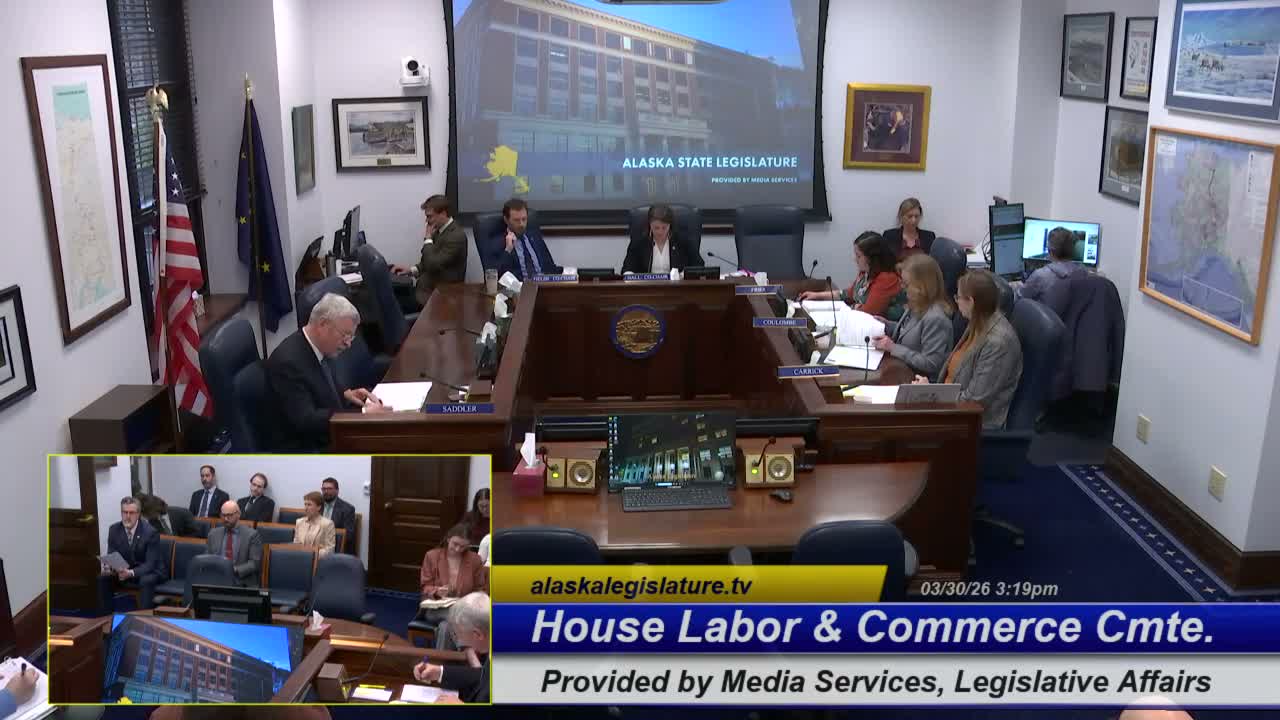
Representative Gray urges inflation index for Alaska's non-economic damage caps
Loading...
Summary
Sponsor Representative Gray and invited experts told the House Labor and Commerce Committee that Alaska's $400,000 cap on non‑economic damages has been eroded by inflation and that HB 316 would add an ongoing CPI‑based adjustment to preserve the legislature's 1997 intent; the committee set the bill aside for a later hearing.
Representative Gray introduced House Bill 316 on March 30, saying the proposal would add an inflation‑adjustment mechanism to Alaska's statutory non‑economic damage caps in AS 9.17.010 to preserve the original intent of the 1997 law.
"This is the straightforward fix needed to honor the legislature's original intent," Representative Gray said, framing the bill as a way to protect victims' compensation without expanding the caps beyond what was contemplated in 1997.
Jason Scala, an Anchorage civil trial attorney, told the committee HB 316 is about access to justice. "By not adjusting the non‑economic damage caps for inflation over the last 30 years, we have severely eroded the ability of victims to recover damages for things like pain, suffering, and emotional harm," he said, adding that rural Alaskans can be disproportionately affected because local costs have risen faster in many places.
Dr. Steve Colt, a professional economist at the University of Alaska Fairbanks, said Alaska's price level is roughly double what it was in 1997 and estimated that a $400,000 cap today has purchasing power similar to about $212,000 in 1997 dollars. "A dollar of compensation is only as good as what it can buy," Colt said, arguing that indexing the caps would restore parity between economic and non‑economic damages.
Staff to the sponsor, Dylan Hitchcock Lopez, described HB 316's mechanics: the bill would create an ongoing inflation‑adjustment tied to a consumer‑price index and can be administered with a typical effective date (for example, Jan. 1) similar to other Alaska statutes. Committee members asked whether the bill applies 100% of CPI change annually; staff said the 100% formulation mirrors other statutes but the sponsor is open to technical tweaks.
Committee members also raised concerns about potential impacts on insurance costs after noting a letter from insurance interests and a fiscal note from the Division of Risk Management. Hitchcock Lopez said historical data show relatively few claims exceed the cap but acknowledged that the long‑term fiscal effect is difficult to quantify and warranted follow‑up with the division.
The chair set the bill aside to be heard again when the committee schedule permits.
The committee did not take a final action on HB 316 during this session; further committee hearings were indicated.