
Alaska House panel hears competing plans to end clock changes as tourism and health experts clash
Get AI-powered insights, summaries, and transcripts
Sign Up Free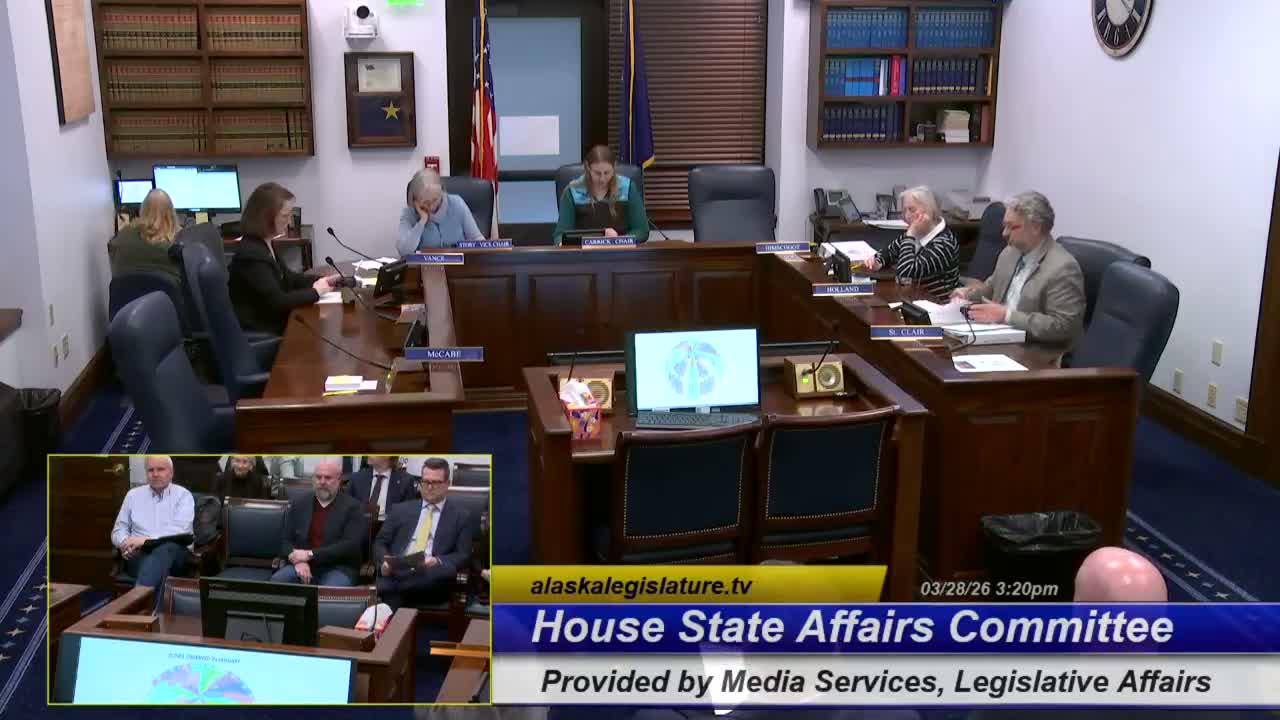
Summary
On March 28 the Alaska House State Affairs Committee held introductory hearings on SB 26 and HB 229, two opposing bills to end twice-yearly clock changes: SB 26 would exempt Alaska from DST and petition USDOT to move the state to Pacific Standard Time; HB 229 would set permanent Alaska Standard Time without federal approval. Testimony split between tourism and business groups backing SB 26 and medical and public-health experts backing HB 229.
Juneau — The Alaska House State Affairs Committee met March 28 for introductory hearings on two competing bills to end the twice-yearly clock change, with tourism leaders arguing to preserve evening daylight and medical experts urging permanent standard time for health reasons.
Sen. Kelly Merrick, sponsor of Senate Bill 26, told the committee the bill would stop the biannual clock switch while keeping Alaska aligned with West Coast economic partners. "They're tired of changing the clocks," Merrick said, calling SB 26 a "practical path" that would exempt Alaska from observing daylight saving time only if the U.S. Department of Transportation places the entire state on Pacific Standard Time on or before 2035. Her staff member Carrie Crocker walked the committee through the bill: section 1 exempts the state from observing DST; section 2 directs the legislature to petition USDOT under the Uniform Time Act of 1966 to move Alaska to Pacific Time; and the DST exemption would take effect only if USDOT acts by 2035.
"This is not a perfect solution for everyone, but a workable solution for Alaska," Merrick said, framing SB 26 as a compromise to avoid leaving the state out of sync with western markets.
Representatives on the committee pressed authors about executive-branch and federal buy-in. Merrick said she had not personally spoken with the current administration about the bill but noted Governor Mike Dunleavy co-sponsored similar legislation in the 29th Legislature; staff explained the bill intentionally allows time for USDOT review and for public proceedings the federal process requires.
The Alaska Travel Industry Association urged the committee to back SB 26. Jillian Simpson, ATIA president and CEO, said Alaska's tourism industry depends on long summer evenings and warned that shifting the state to permanent standard time would move valuable evening daylight into early morning hours that visitors would not use. "More than 3,000,000 visitors traveled to Alaska last year, contributing $5,600,000,000 to the state's economy and supporting 48,000 jobs," Simpson said, arguing that the bill preserves the summertime schedule essential to tour operators and cruise itineraries.
By contrast, Representative Kai Holland and a bloc of public-health witnesses urged the committee to back House Bill 229, which would unilaterally put Alaska on permanent standard time without federal action. "This is the only way to guarantee we end the practice of changing the clocks now," Holland said, describing HB 229 as an exercise of the state's authority under the Uniform Time Act.
Medical witnesses told the panel permanent standard time better protects circadian health. Dr. Kristen Mitchell, past president of the Alaska State Medical Association and a sleep medicine specialist, said the human circadian clock is set by sunlight rather than by the social clock and that transitions to daylight time cause circadian misalignment linked in multiple studies to increased cardiovascular events, motor-vehicle fatalities and a measurable rise in suicide rates in the week after the spring change. "Because of our western position in the time zone and extreme seasonal light variation, Alaska is particularly vulnerable to circadian misalignment," Mitchell said.
Dr. Kathy Gallardo, a board-certified psychiatrist who testified for HB 229 supporters, said morning light is critical to serotonin and cortisol regulation and that population-level data show psychiatric admissions and mood-disorder signals increase following springtime clock shifts.
The committee also heard polling and technical evidence. Everett Masterman of Alaska Survey Research described a split-sample poll he shared with the committee: when asked about making time the same year-round, 63.5% of respondents strongly supported the change; in a follow-up comparing permanent daylight saving time and permanent standard time, 57.8% preferred permanent daylight saving time while 27.6% preferred permanent standard time. Masterman cautioned that question wording and order can affect results.
Public testimony was divided. Visitors and tourism operators from Southeast Alaska and sightseeing pilots said SB 26 would preserve business hours and visitor experiences. Tom Williams, who operates charter and tourism services in Juneau, urged support for SB 26 to avoid reductions in summer operations. Community and medical witnesses from interior and western Alaska said permanent standard time would better protect students, shift workers and people with circadian vulnerabilities; Jay P., president of Safe Standard Time (a national coalition of sleep and medical groups), urged the committee to reject SB 26 and adopt the guaranteed health protections of HB 229.
Committee members repeatedly asked whether lower-latitude studies apply in Alaska and whether spring-transition signals persist at northern latitudes; medical witnesses said Alaska-specific data are limited but pointed to Scandinavian registry studies and to biological plausibility for heightened risk on the western edge of a time zone.
No formal action or votes were taken; Chair Kerrick set both bills aside. The committee announced plans to take up a third option (House Bill 41) and other items at a March 31 meeting. "Part of the reason we held this hearing on a Saturday was to ensure that public testifiers would have maximal opportunity to be here," Kerrick said before adjourning at 5:28 p.m.
What’s next: The committee will hear a third proposal and may continue deliberations; any change that would put Alaska on permanent daylight saving time would require USDOT or congressional action, while a move to permanent standard time can be implemented unilaterally under current federal law.