Get Full Government Meeting Transcripts, Videos, & Alerts Forever!
Get email alerts on the Mtss topic
No spam. Unsubscribe anytime.
Alaska educators describe MTSS as framework, not mandate, stress statewide support effort
Summary
Alaska Staff Development Network director Douglas Gray told a joint House–Senate education committee that MTSS (multi-tiered systems of support) is a flexible framework for early identification and intervention, not a new program, and announced a statewide consortium with UAA to develop resources for districts.
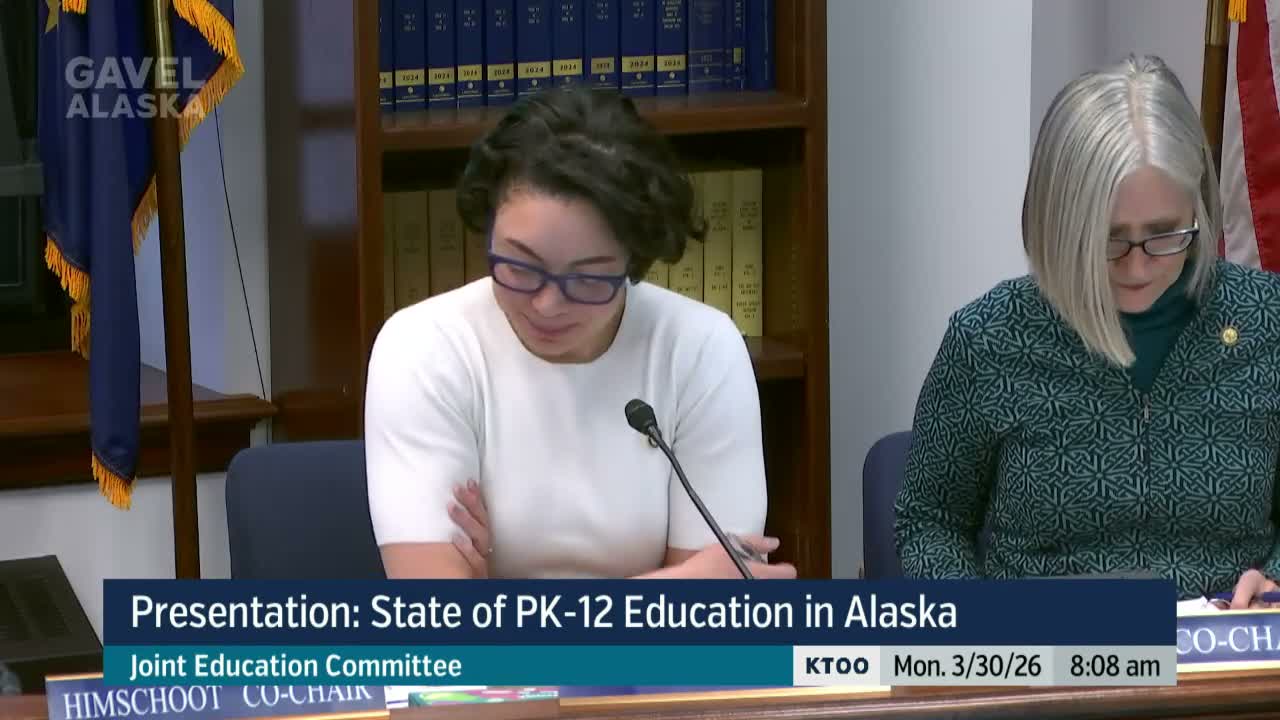
Douglas Gray, professional development director for the Alaska Staff Development Network, told the joint House and Senate education committees on March 30 that MTSS — multi-tiered systems of support — is a flexible organizing framework designed to "identify students early, respond quickly, and match the level of support to the level of need." Gray said MTSS is "not a new program. It is not a mandate. It is not a curriculum," and described it as a preventative approach that moves students between support levels "based on data and not labels."
Gray used classroom examples to illustrate MTSS in practice, saying a second grader could receive small-group reading support and return to grade-level within six weeks, and a tenth grader showing behavioral issues could be supported through targeted interventions rather than punishment. He told lawmakers MTSS aligns with the Alaska Reads Act and can improve fiscal efficiency by reducing demand for more intensive, costly services later.
Gray also described a new, integrated MTSS consortium that pairs districts with University of Alaska Anchorage researchers and statewide partners to create shared academic, behavior and mental‑health resources. "This is a grassroots effort...so smaller districts do not have to do this work alone," he said.
Committee members asked how MTSS training is delivered in a fiscally constrained environment. Gray said the network is increasing virtual offerings, creating asynchronous modules educators can access on their own time, and coordinating in‑person events around existing travel to reduce cost and district burden. He said the network serves thousands of educators annually and runs the state's largest education conference each January.
Legislators also asked whether MTSS works when class sizes grow. Gray acknowledged larger classes increase the risk that students will "fall through the cracks" and said the framework helps catch such students sooner if implemented well. He emphasized MTSS is intended to organize supports already present in schools rather than add an additional program.
The committee did not take formal action on MTSS; members asked staff to track implementation evidence and consider how state policy and funding can expand technical assistance for districts implementing the framework.