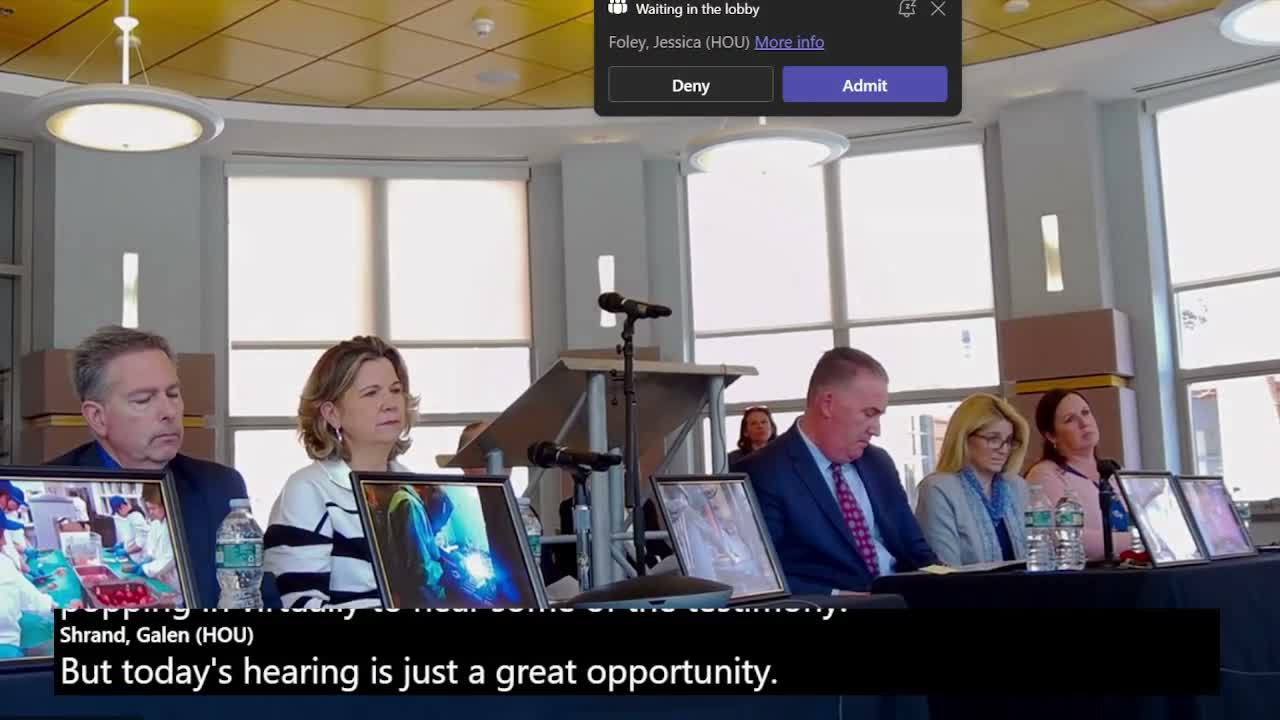
Quincy school leaders, students and employers showcase career and technical education to state committee
Loading...
Summary
Quincy Public Schools told the Massachusetts Joint Committee on Education about enrollment growth, Chapter 74 work, employer partnerships and new student credentials — including planned OSHA 10 access and recent Skills Capital and Project Lead The Way grants — while students described hands-on experiences that lead directly to jobs or college.
Quincy Public Schools presented its career and technical education (CTE) programs to the Massachusetts Joint Committee on Education in a visit intended to inform state legislation on CTE access and standards.
Superintendent Kevin Mulvey welcomed committee members and said Quincy’s CTE programs “are more than pathways. They are powerful opportunities that prepare our students for meaningful careers, lifelong learning, and active participation in a rapidly evolving economy.” He introduced a team of administrators, instructors, employer partners and students who described program structures, partnerships and credentials.
The district reported roughly 1,360 students enrolled across Quincy High School and North Quincy High School CTE programs, an increase of about 60 students from the previous year. Presenters emphasized that local programs follow the Massachusetts Department of Elementary and Secondary Education (DESE) Chapter 74 frameworks, which define industry-recognized competencies and safety standards for each pathway.
An administrator said the district will offer OSHA 10 (general or construction) credentials to students next year as part of an effort to standardize safety training across programs. Quincy also described capital and planning funding from several sources: the Massachusetts Skills Capital Grant Program (which provides awards of up to $750,000), recent Project Lead The Way grants for computer-science curriculum ($23,000 and a separate $10,000 award), and roughly $2.3 million in grant awards the district has pursued over the past eight years. The presentation also cited federal Carl D. Perkins funding as a major support for CTE nationally.
District staff outlined a pending Chapter 74 application for a four-year engineering program at North Quincy High School. The speaker said the application included both Part A and Part B submissions to DESE, with an on-site program-safety review and advisory-board meeting expected as next steps. A separate $30,000 planning request tied to the engineering proposal was described as intended to purchase student equipment and fund teacher training while the DESE approval is pending.
Employers and advisory-board members described how local partnerships connect students to co-op and apprenticeship experiences. "We were able to make this work first thing in the morning for my company," said David Devona, owner of First Class Plumbing and Heating, describing a co-op schedule in which students work roughly 6:30 a.m. to 10:30 a.m. before returning to school. Devona said those employer-led opportunities include hands-on training, certificates in gas and water piping, and mock interviews to prepare seniors for job searches.
MassHire South Shore’s Mary Kate Paris said regional workforce boards provide labor-market data and letters of support to align Skills Capital applications with local industry needs and described YouthWorks and the "Ladders to Success" program as summer pathways that connect students to early work experiences.
Erin Perkins, assistant superintendent, described myCAP (My Career and Academic Plan), a student-directed college and career planning framework supported by a DESE planning grant. Perkins said Quincy is reviewing tools such as Naviance and the MEFA Pathway platform to centralize student planning, document progress over time and expand work that begins in middle grades.
Students told committee members how CTE changed their plans. "I fell in love with the trade," said Ellie Crump, a senior in metal fabrication and welding, who described earning OSHA 10 and pursuing American Welding Society certifications before she attends Wentworth Institute of Technology. Emily Fantino, a senior in Early Education and Care, described clinical placements at Bernasani Elementary and credentials including CPR/AED and mandated-reporter training. A senior in the healthcare program, who identified himself as Alex, described clinical work at Hancock Park and preparing to pursue nursing.
Committee members thanked Quincy staff and students, said the visit would inform Beacon Hill deliberations on CTE legislation and graduation standards, and adjourned the session. No formal votes were recorded during the visit.
The committee indicated it will carry insights from the visit back to Beacon Hill as members continue work on bills related to expanding CTE access and modernizing equipment and credentials.