Mass. committee hears competing testimony on ballot petition to repeal adult-use cannabis law (H.5002)
Loading...
Summary
A special joint legislative committee heard expert, proponent and industry testimony on initiative petition 2510 (H.5002), which would roll back Massachusetts’ adult-use cannabis laws; witnesses disputed public-health data and clashed over economic and social-equity consequences.
The Special Joint Committee on Initiative Petitions heard oral testimony and public comment on initiative petition number 2,510 (filed as H.5002), an act “to restore a sensible marijuana policy,” during a March public hearing.
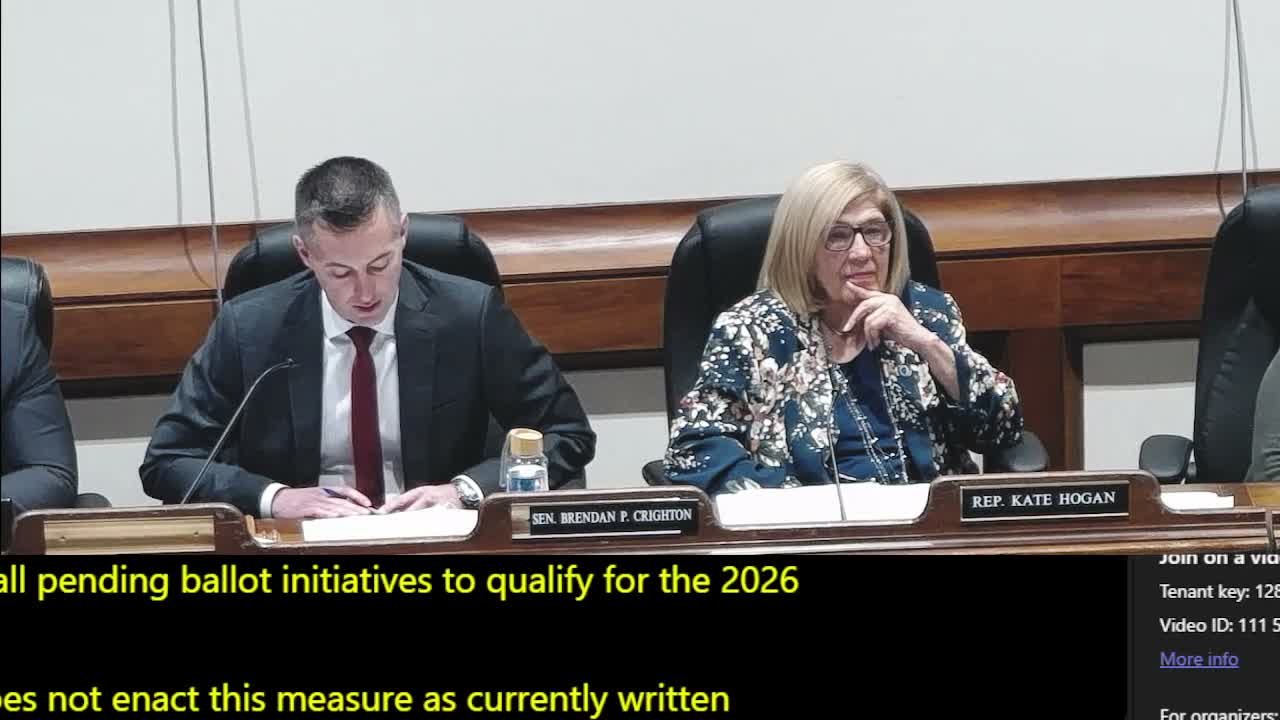
The panel included Senate and House leaders and heard experts, proponents and opponents over two panels and a public-comment period. Committee members said written testimony will be accepted through March 27 at 5 p.m.
Jessica Tro, deputy director of research and policy analysis at the Massachusetts Budget and Policy Center, opened for 30 minutes and outlined how cannabis-related revenues flow in the Commonwealth. Tro said licensing fees and fines together with a 10.75 percent excise tax are deposited into the Marijuana Regulation Fund; about 85 percent of that fund, she said in testimony, supports line-item spending — including public-health programs and the Bureau of Substance Addiction Services — and roughly 15 percent is directed to a Cannabis Social Equity Fund established in the 2022 equity bill. In her oral testimony Tro cited totals for FY2018 through FY2025, saying state and local cannabis receipts have approached $2 billion and that sales-tax collections related to cannabis amounted to over $500 million in that period. Tro also explained that the 6.25 percent state sales tax on cannabis includes transfers—one cent to the MBTA and one cent to the Massachusetts School Building Authority—and that cities and towns may impose a local tax (up to 3 percent) and community impact fees; she said those local levies have generated substantial municipal revenue and that Boston operates its own local equity program.
Proponents of H.5002 framed their case around public-health and safety concerns. Wendy Wakeman, identifying herself as spokesperson for the ballot committee backing the petition, told the committee legalization has raised product potency, addiction and mental-health concerns, increased emergency-room visits and pediatric exposures to edibles, and failed to eliminate the black market. Wakeman cited national and out-of-state studies and examples—she mentioned Colorado and Maine during her remarks—and said she believes the overall effect of legalization has been “not a net positive” for Massachusetts. Committee members pressed Wakeman on data sources, Massachusetts-specific evidence and the petition’s funding; Wakeman acknowledged some of her slides drew on out-of-state analyses and said signature-gathering was largely paid rather than volunteer-driven, while filings discussed during questioning showed substantial contributions from out-of-state groups according to OCPF records referenced by committee members.
Opponents — including licensed social-equity operators, industry executives and patient advocates — warned that repealing the state's regulated adult-use system would eliminate jobs, cut state and local tax revenue and harm patient access to regulated, tested products. Caroline Pino, owner of STEM in Haverhill and a licensed economic-empowerment operator, said the retail and associated supply-chain jobs and hundreds of millions in taxes would be lost under repeal. Kristin Rogers, CEO of Levia, and Armani White, a social-equity operator and co‑founder of Equitable Opportunities Now, emphasized the industry’s social-equity programs and argued repeal would re-create the pre‑legalization harms for communities of color. Nurse and patient-access advocate Judith Ledbetter urged investment in research and education rather than repeal, saying reduced visibility into use would hinder clinical care and patient safety.
Several public commenters reiterated those concerns. Lucas Thayer of the Massachusetts Cannabis Reform Coalition and Jeff Rawson, a chemist who said he founded a consumer-protection nonprofit, told the committee that regulated dispensary products are generally safer and more accurately labeled than black‑market alternatives; Rawson recounted a hospitalization he attributed to an illicit vaping product.
Committee members repeatedly asked for clearer Massachusetts-specific data and questioned the petition’s sponsorship and fundraising. The hearing record shows committee members discussed Article 48 procedures, and Tro and other witnesses repeatedly noted gaps in statewide research while attributing specific multi‑year revenue and fund‑allocation figures to Tro’s written testimony. The committee also noted an additional signature threshold of 12,429 required for pending initiatives to reach the 2026 ballot if the Legislature does not enact the measure as written.
No vote or formal committee action on the substance of H.5002 was recorded in the oral hearing; a motion to close the hearing was moved and seconded before the committee adjourned. The panel invited written testimony to supplement the record.
What’s next: The committee will accept written testimony electronically through the posted deadline; there was no indication in the hearing record of a scheduled committee vote date.