Committee on Election Laws hears support for House Bill 5,086 to bar faithless presidential electors
Loading...
Summary
Witnesses told the Committee on Election Laws that House Bill 5,086 would prevent 'faithless' presidential electors, replace any elector who breaks a pledge, and help Massachusetts meet federal electoral deadlines; experts said the bill is compatible with the National Popular Vote compact with a clarifying amendment.
At a hearing of the Committee on Election Laws, witnesses urged lawmakers to report out House Bill 5,086 with a favorable recommendation, saying the bill would ensure Massachusetts’ presidential electors honor voters’ choices and reduce the risk of coercion.
"At this moment in our nation's history, there's almost nothing more important... than making sure that voters' voices and choices are honored," Liz Iacobucci, Protect Elections campaign coordinator for Public Citizen, told the committee, urging an "ought to pass" report. She said the measure would "insulate" electors from pressure and replace any elector who casts a faithless vote.
Carrie Behrman, legislative counsel at the Uniform Law Commission, told the committee that HB 5,086 would enact the Uniform Faithful Presidential Electors Act in Massachusetts. "The bill requires each elector to execute a state‑administered pledge of faithfulness," she said, and if an elector attempts to vote contrary to that pledge the bill would treat the elector as having resigned and provide a procedure to promptly fill the vacancy and amend the federal certificate of ascertainment so the official record reflects faithful votes.
David Weinberg, a policy strategist with Protect Democracy United, recommended voting the bill out of committee with minor clarifying amendments. He described the bill's "automatic replacement" approach and said similar laws are already in place in many states: "You actually have 26 states now that have adopted such laws," he said, and he noted that the approach has been upheld by the U.S. Supreme Court in 2020 rulings. Weinberg also recommended a narrow amendment to make explicit that the bill does not contradict Massachusetts' membership in the National Popular Vote interstate compact and suggested language to help ensure post‑election litigation is resolved in time to meet shortened federal deadlines.
Representative Tim Frost asked whether the bill could conflict with the National Popular Vote compact — which provides that, if enough states join, a state's appointed electors would reflect the national popular vote rather than that state's popular vote — and whether Massachusetts should instead consider decoupling from the compact. Weinberg replied that the bill, as drafted, is "fully compliant" with the compact and that a brief clarification in section 1 would prevent misinterpretation while preserving the bill's protections.
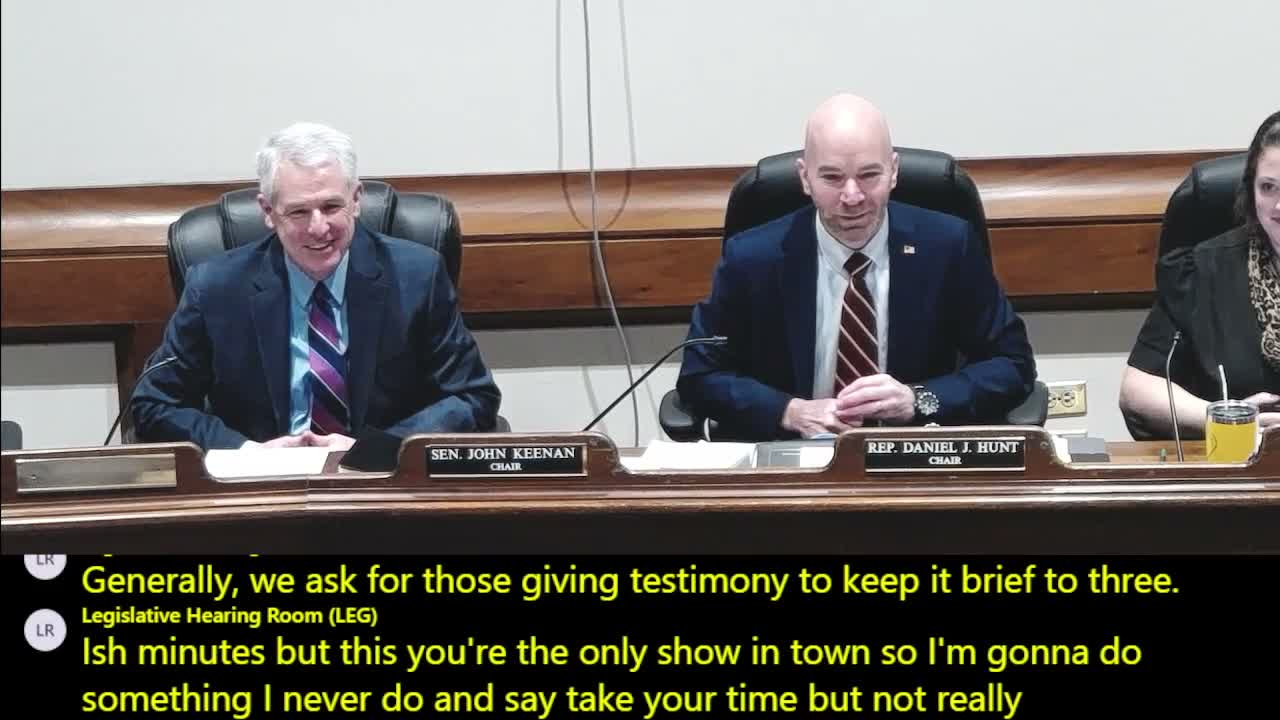
Committee members did not take a vote on HB 5,086. Chair Dan Hunt closed the hearing after noting additional testimony filed on the other two bills and accepting a motion to adjourn. The committee adjourned without voting on HB 5,086.
Background: witnesses framed the bill as a post‑2020 measure to reduce the potential for coercion of electors and to align state procedures with the federal Electoral Count Reform Act's timing and paperwork requirements; proponents cited the Jan. 6, 2021 attack on the U.S. Capitol and recent instances of threats against officials as motivation for stronger safeguards.