Lawmakers hear advocates on proposal to dedicate sporting-goods sales tax to conservation
Loading...
Summary
Supporters told the Special Joint Committee on Initiative Petitions that the "Protect Water and Nature" petition (H.5005) would create a steady revenue stream — proponents estimate up to about $100 million annually when fully phased in — to close a conservation funding gap they place at roughly $300 million a year needed to meet the state’s 30% by 2030 goal. Lawmakers pressed proponents on constitutionality, the bill’s governance language and whether the language effectively directs legislative appropriation.
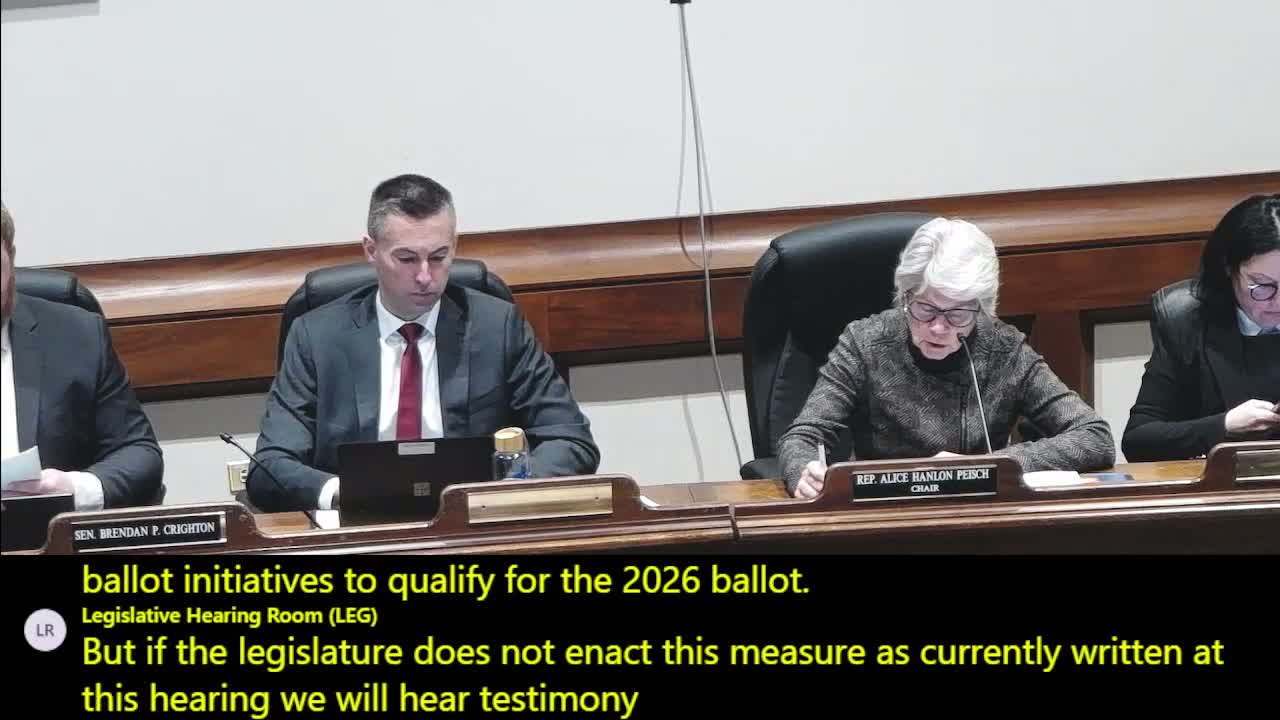
The Special Joint Committee on Initiative Petitions heard more than two hours of testimony on Initiative Petition No. 25-15 (H.5005), commonly framed by proponents as the "Nature for Massachusetts" or "Protect Water and Nature" initiative, which would dedicate a portion of the sporting‑goods sales tax to a new conservation and water-protection fund.
Under Secretary Stephanie Cooper of the Executive Office of Energy and Environmental Affairs told the committee that Massachusetts already programs about $40,000,000 a year in capital spending for land conservation and relies on a mix of capital authorizations, federal grants, trust funds and municipal Community Preservation Act revenue. "These programs are oversubscribed," she said, and she urged the petition drafters to clarify administrative and governance details, noting the measure does not explicitly state whether the new board would be housed administratively within EEA.
Supporters — including David O'Neil, president and CEO of Mass Audubon; Katie Theoharides of The Trustees of Reservations; Emma Ellsworth of Mount Grace Land Trust; and others — urged the committee to advance the legislative companion but said the ballot measure offers a backstop. O'Neil told lawmakers the coalition’s analysis found the Commonwealth "may require at least an additional $300,000,000 per year or more to reach the state's 30 by 30 conservation goal," and highlighted the coalition’s public polling and private fundraising in support of the measure. "Nature gives us so much. It's very much a joyous prescription for all that ails us," O'Neil said.
Proponents outlined the revenue design and scale. They said the initiative would phase in by redirecting 50% of specified sporting‑goods sales-tax revenue in year one and the full designated amount thereafter, and estimated the program could reach roughly $100,000,000 annually when fully funded, depending on taxable receipts. Coalition testimony identified three NAICS codes used to scope the revenue base: sporting‑goods retailers, recreational‑vehicle dealers and golf courses/country clubs.
Committee members focused their questions on several implementation points. Senator Barry Feingold and others asked whether the petition had been reviewed for constitutionality; proponents said they retained counsel and would submit a memo. Members probed the meaning of a provision that makes spending "subject to appropriation by the legislature." Sam Anderson, a coalition government‑affairs representative, told the committee that the ballot cannot itself appropriate funds and that the intent is to create a dedicated fund and urge the Legislature to appropriate for its use. As Anderson put it, the ballot is designed to "set up this fund and send a message" to the Legislature rather than to compel immediate spending.
Lawmakers also pressed proponents for distribution criteria. Proponents said allocations would likely use existing grant criteria that prioritize large, connected blocks of forest and projects that advance biodiversity and water protection, and that a needs‑based lens would help direct funds to underserved communities and rural towns that do not participate in the Community Preservation Act.
The hearing included scrutiny of campaign financing and signature gathering. A committee member cited the campaign’s OCPF filings showing roughly $1.38 million in donations, including paid signature‑gathering costs; proponents said volunteers and coalition members gathered about 15% of signatures and that paid firms handled the bulk of collections. Representative concerns included whether wealthy donors could dominate access to the ballot compared with candidate contribution limits.
Speakers from environmental organizations and local land trusts stressed the urgency of steady public funding to protect drinking-water zones, habitat and coastal resilience. Mount Grace's Emma Ellsworth detailed rising land prices and immediate project shortfalls: "We have 40 active conservation projects. That's $21,000,000 worth of conservation costs," she said, and described a $6,000,000 shortfall on current projects in her region.
No formal votes were taken; the committee closed the public‑testimony portion of the hearing and will accept written testimony through Friday, March 27 at 5 p.m., posting instructions on the Legislature's website. The committees indicated interest in the legislative companion bills and asked proponents for follow‑up materials on constitutionality, revenue estimates and governance clarifications.
Why it matters: Proponents say the measure would create a predictable, dedicated revenue stream to address an identified gap between existing conservation programs and the funding needed to meet statutory and executive biodiversity and climate goals. Opponents and some lawmakers warned that the redirection of sales-tax revenue reduces amounts otherwise available for general appropriation and flagged constitutional and appropriation questions that the committee asked proponents to resolve.
What’s next: The committee will accept additional written testimony and may return the petition to committee work for follow‑up analysis. The petition remains scheduled for the 2026 ballot unless the Legislature enacts the measure as filed or takes other action.