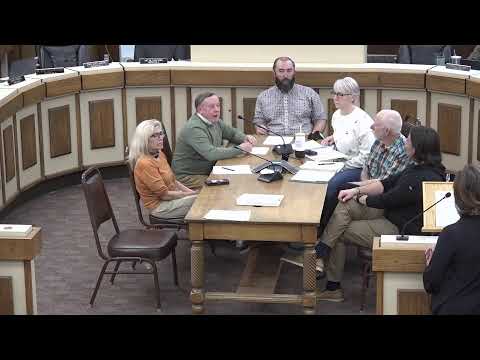
Commissioners discuss adding 3 MCT to fire district amid questions about taxes and staffing
Loading...
Summary
County attorneys and staff told the judiciary committee that expanding the Butte-Silver Bow fire services district to include the 3 MCT area would add commercial parcels to the tax base; commissioners pressed for maps, historical staffing-cost data and clearer fiscal projections before any ordinance adoption.
Chairwoman Shea opened discussion of an ordinance of intent to alter the City-County of Butte-Silver Bow fire services district to include the 3 MCT area, saying county staff had previously presented the proposal and the committee needed a staff timeline and report.
County Attorney Andrew described the item as a resolution of intent that would allow the county to modify district boundaries by local ordinance rather than through the state process. He noted drafting errors in the submitted resolution ("fee" should be "tax") and said multiple public hearings are required before final ordinance adoption.
Director Hassler, the budget director, told commissioners preliminary calculations are difficult because of recent changes in state tax-rate formulas and an ongoing reassessment. Using last year's taxable values as a baseline, Hassler offered sample impacts: "For a $100,000 home, the tax would be $42.29," and he said a $400,000 home would be roughly $169.18 under last year's levies. He added that the state median home value of $378,000 and a published median commercial value of $2,274,000 complicate straightforward comparisons because rates are now tied to median values published by the Department of Revenue.
Commissioner Callahan pushed back, saying earlier presentations implied the expansion was for commercial property (Connection Park) only and asking for a clear map. "We didn't get a map," Callahan said, requesting a real map so the committee could confirm how many residences would be included. He also questioned fairness and cited ASME's historical payments: "One hundred thousand a year for 30 years, ASME's paid over $3,000,000," Callahan said, and asked whether the site would start paying more under the change.
Mr. Silk, speaking for emergency-response operations, emphasized mutual aid and assured the committee the county would respond to 911 calls in the 3 MCT area and that private and county responders train and work together. "If there is a 911 call that comes in, we will respond out there," he said, and added that industry brigades and regional hazmat teams supplement county resources for specialized incidents.
Director Hassler said last year's countywide billing at 11.33 mills produced $100,830 and that earlier revenue estimates for adding 3 MCT to the district had ranged roughly from $300,000 to $350,000, but final numbers depend on certified values and current legislative rules. Commissioners requested additional information, including (1) a clear map of the proposed boundary change, (2) the detailed taxable-value calculations using the relevant certified values once they are available, and (3) historical personnel- and overtime-cost data to show whether previous hires reduced overtime costs before approving positions funded by any new district revenue.
Mr. Lee told the committee suggested new positions were examples, not set in stone, and that any hires would go through the normal budget process, including presentation by Zach Winch to budget staff and commissioners. Commissioner Callahan reiterated skepticism about adding positions that had been unnecessary for decades, and Chairwoman Shea said the commission controls how additional revenue would be spent and emphasized that bringing properties into the tax base is the purpose of economic development efforts.
No ordinance adoption vote was taken; County Attorney Andrew said the process requires multiple public hearings and further legislative steps before any change could be adopted.