Lifetime Citizen Portal Access — AI Briefings, Alerts & Unlimited Follows
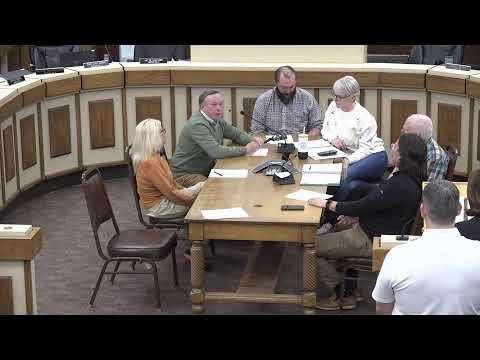
Judiciary committee schedules April 15 hearing, holds resolution to add Montana Connections TED to uniform fire district
Loading...
Summary
The Butte-Silver Bow judiciary committee voted to hold Resolution 2026-18 for two weeks and set a public hearing on April 15 to consider including the Montana Connections TED (3 MCT) in the county'wide uniform fire district. Debate centered on rising emergency-call volumes, SAFER grant staffing history and concerns about tax timing for local businesses.
The Butte-Silver Bow judiciary committee voted to hold Resolution 2026-18 for two weeks and schedule a public hearing on April 15 to consider expanding the county'wide uniform fire district to include the Montana Connections TED (3 MCT).
The action follows a lengthy committee discussion about firefighter staffing, funding sources and the distribution of emergency calls. Fire marshal Lee told the committee the presentation outlined "ideas for his presentation. Nothing is set in stone," and said staffing and apparatus purchases were being presented as potential options rather than firm commitments. Lee added: "When I started in 2008, we had 2,962 calls... and then that just this last year, we had 5,331 calls," which he used to justify planning for additional capacity.
Several commissioners pressed staff for details about who pays and who receives services. Director Bert Hassler said every property countywide pays about 11.33 mills for emergency services and that the emergency-services FY25 budget was roughly $1.186 million, with 3 MCT contributing about $100,000 of that total last year. "Everybody countywide pays for 11.33 mills for emergency services," Hassler told the committee while providing the FY25 figures.
Opposition in the committee focused on timing and fairness. Commissioner Fisher said the county is collecting significant tax revenue from the TIF/TED area and argued it might be unwise to add a tax during a period of recent layoffs and business stress. "I'm not against this, but timing isn't good right now," Fisher said, arguing a countywide levy might spread the burden more evenly. Commissioner Minkins raised similar concerns for small businesses, urging that any expansion be "consistent and fair" so mom-and-pop shops do not shoulder disproportionate costs.
Several members also requested more data before any final action. Commissioner O'Leary asked staff for a breakdown showing how call volume is distributed geographically; the committee asked planning and GIS staff to evaluate whether boundaries could instead be drawn by response-time contours (for example, a 15-minute response area) to match service patterns.
Legal and procedural questions were addressed on the record. Former budget director Gleason reviewed historical changes in state law that affected mill-levy calculations, noting a shift after House Bill 124 in 2003 that altered the earlier I-105 scheme and limited the county's reduction ability. County Attorney Enruth explained the role of a resolution of intent: it increases public notice and triggers additional hearings and publication requirements before any ordinance change would take effect.
Commissioner Callahan moved to hold the resolution for two weeks and add a public hearing on April 15; the motion was seconded and passed by voice vote. The committee's formal action does not itself expand the fire district: if the council later approves ordinance changes, those amendments would require public hearings and a 30-day effective period after passage before appearing on tax rolls.
Next steps: staff agreed to provide the committee with call-distribution data and possible GIS-based boundary options; the committee will convene the scheduled public hearing on April 15 where businesses and residents will have an opportunity to comment before any ordinance is advanced.