Lifetime Citizen Portal Access — AI Briefings, Alerts & Unlimited Follows
Committee hears bill to modernize veterinary practice, expand scope for licensed veterinary technicians
Loading...
Summary
Senate File 4069 would modernize Minnesota’s Veterinary Practice Act—establishing licensure and continuing education for veterinary technicians, clarifying telemedicine and supervision rules, and updating board composition. The committee adopted technical amendments and laid the bill over for possible inclusion.
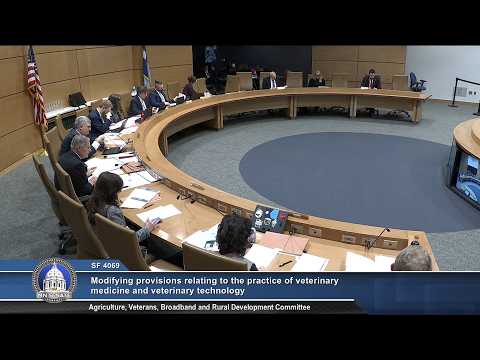
The committee considered Senate File 4069 on March 11, a comprehensive update to Minnesota’s Veterinary Practice Act designed to reflect current veterinary care models and to expand the regulated scope for licensed veterinary technicians.
Senator Kupak summarized the measure as modernizing definitions, expanding board membership from seven to nine members to add a licensed veterinary technician seat, formalizing telemedicine while preserving a veterinarian‑client‑patient relationship (VCPR), clarifying remote supervision and delegation to technicians, and aligning drug definitions with federal law. The A1 amendment—based on stakeholder feedback—was adopted to incorporate technical and stakeholder changes.
Dr. Pam Johnson, Executive Director of the Minnesota Board of Veterinary Medicine, testified the bill clarifies scope, supervision, record keeping and disciplinary grounds for technicians and aligns the VCPR with national and FDA guidance. She said the bill defines a timely in‑person exam as occurring at least once every 12 months and noted that 42 other states use a similar 12‑month standard. On questions about farriers and diagnosis, Dr. Johnson said routine farrier work (trimming and foot care) does not constitute diagnosing disease, but diagnosing an unsoundness tied to disease should involve a licensed veterinarian.
Britney Johnson (Minnesota Farmers Union) testified that limited access to large‑animal veterinarians—particularly during lambing season—forces producers to travel long distances for treatment or forgo programs that require veterinary help (for example, OPP‑free certification in sheep), and she said expanding technician scope would improve on‑farm access to care.
Committee members asked about the extent of alternative or integrative therapy providers that would be affected; Dr. Johnson said the board did not have research quantifying such providers and offered to follow up. Senator Doernick successfully moved a small technical A2 amendment to retain a statutory reference to the board seal; the amendment was adopted. Senator Kupak said the amended bill would be laid over for possible inclusion in omnibus language.
Next steps: SF4069 was amended and laid over for possible inclusion; legislators and board staff flagged follow‑up work on research about alternative therapies and definitions for certain terms.
Direct quotes from the hearing: Dr. Johnson said the bill "modernizes the regulatory framework to reflect current veterinary practices" and that the board believes timely exams "currently means every 12" months; Britney Johnson said, "I'm currently smack dab in the middle of lambing season" to explain the urgency of technician access for producers.
The committee did not record a final referral to the floor on SF4069 during this hearing.