Get Full Government Meeting Transcripts, Videos, & Alerts Forever!
Get email alerts on the Dpw Budget topic
No spam. Unsubscribe anytime.
Finance committee unanimously recommends DPW budget after multi‑division presentation
Summary
The Finance Committee voted unanimously to recommend the Department of Public Works budget after a detailed presentation from DPW leadership that highlighted staffing needs, a $3M police HVAC project, sludge disposal challenges, and proposals to centralize vehicle maintenance.
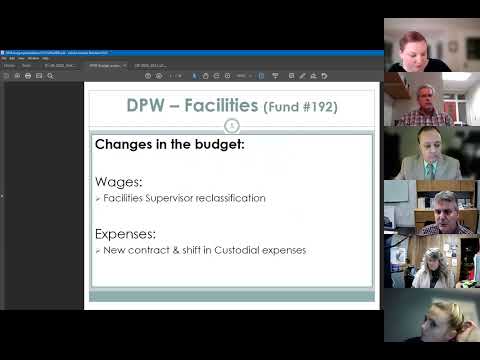
The Town of Yarmouth Finance Committee voted unanimously to recommend the Department of Public Works (DPW) budget as presented after a detailed remote presentation by DPW director Jeff Colby and his leadership team.
Jeff Colby summarized DPW operations and recent projects and said the department completed a new DPW building (ribbon cutting last November), completed Higgins Kroll shared‑use path phase 1 and Parker’s River work, and carried out roughly 19 miles of pavement maintenance during the last year. He also flagged an in‑progress, approximately $3,000,000 project to replace the police station HVAC system and said the work is about halfway done and expected to finish in spring.
The presentation emphasized personnel and maintenance strains. Colby said staffing is a top priority if additional funds become available, noting a pattern of attrition and position eliminations going back to the 2008–2010 budget reductions. On centralizing maintenance, Colby recommended bringing more vehicle work in‑house rather than contracting out, citing a Weston & Sampson analysis that full in‑house maintenance would require about eight mechanics; Colby said the town can incrementally add mechanics to reduce contracted repairs.
Committee members pressed for clarity on enterprise funds and retained earnings related to DPW operations. Colby said the septic/septage enterprise fund is self‑supporting and retains roughly $4 million in retained earnings as a cushion, while noting that septage revenues fluctuate with market activity and hauler choices. He described options under evaluation to reduce sludge disposal costs, including anaerobic digestion, because Massachusetts disposal options are limited and PFAS rules have restricted prior outlets.
On trees and vehicle maintenance budgets, Colby said historically the tree account required roughly $50,000 a year but FY22 had been cut and the proposal restored $10,000 for FY23; he recommended larger investments to meet ongoing needs. For vehicle maintenance, the DPW proposed a modest $10,000 increase for FY23 but said a number closer to $50,000 would be more realistic to reduce longer‑term repair costs.
The committee moved and seconded a recommendation to support the DPW budget as presented. The motion passed unanimously.
What happens next: The Finance Committee’s recommendation will go to town meeting as part of the annual budget process. Committee members asked DPW staff to return for future briefings on wastewater project timing and the enterprise‑fund funding picture.
Representative quotes from the presentation and discussion include:
"It's a excellent building that, meet the needs, of the DPW and the town for many years to come," Colby said about the new DPW facility.
On sludge disposal, Colby said: "Currently, we dispose of our sludge after we dewater it as much as we can, in a tractor trailer, and it gets hauled all the way to Upstate New York, Seneca Falls landfill. And so the cost of doing that is, as you can imagine, very expensive to send tractor trailer loads that far."
The committee asked staff for clearer enterprise fund balance sheets and O&M forecasts so volunteer members can more easily assess retained earnings and fund cushions.
Ending: The Finance Committee voted to recommend the DPW budget; committee members asked staff to bring more detailed fund analyses and a wastewater timeline to a follow‑up meeting.