Get Full Government Meeting Transcripts, Videos, & Alerts Forever!
Get email alerts on the Education Budget topic
No spam. Unsubscribe anytime.
Dennis–Yarmouth schools present FY23 budget outlook as state aid rises
Summary
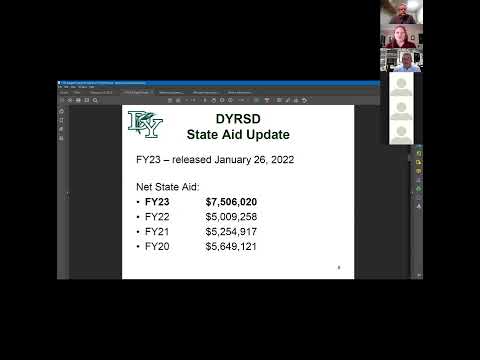
Dennis–Yarmouth Regional School District finance staff presented the FY23 budget and said a proposed Student Opportunity Act adjustment would raise net state aid for the district by roughly $2.5 million, driven largely by expanded low‑income and English‑learner weightings; the district cautioned the increase may not be repeated next year.
David Flynn, representing the Dennis–Yarmouth Regional School District, presented the district’s FY23 budget outlook to the Town of Yarmouth finance committee, saying a change in the state’s Student Opportunity Act would substantially increase the district’s state aid for the coming year.
Flynn told the committee the governor’s January proposal would boost the district’s net state aid by about $2,496,000 compared with the current year. He attributed most of the increase to higher foundation rates for special education, guidance, English‑language learners and expanded low‑income eligibility that the state moved from 133% to 185% of the federal poverty level.
The presentation explained how the foundation budget uses a five‑year rolling average of “foundation enrollment” — students for whom the district is financially responsible, including some school‑choice and charter students — and how per‑student weights in different bands translate to dollars. Flynn cited a district weighted foundation per‑pupil figure of about $14,330 and noted the base foundation amount without add‑ons is roughly $9,476 per pupil.
Flynn also cautioned that the governor’s version is subject to amendment by the House and Senate, and that the sizable increase seen in FY23 likely reflects a one‑time bump tied to how the state adjusted subgroup definitions and rates. “I just wouldn’t count on thinking that we’re gonna get 2 and a half million dollars again next year,” he told members.
Committee members asked for follow‑up data on teacher salaries, regional per‑pupil spending and the district’s comparisons with other communities; Flynn said he would compile salary and comparative material for members. He and members also discussed district capital needs, routine maintenance versus major capital projects, and an outstanding bond anticipation note the town expects to pay off at or before town meeting.
The presentation included a district capital list (examples: pickup trucks, a fire alarm panel, parking/drainage work, interior painting), routine maintenance allocations the superintendent would like to fund from operating lines rather than bonding, and the district’s plan to reapply to the Massachusetts School Building Authority to evaluate Emmy/Station Avenue options.
Flynn repeatedly told members that some of the headcount increases reflected changed state definitions rather than sudden demographic shifts: by widening the low‑income threshold, more families qualify in the low‑income band, which increased the district’s eligible headcount and funding in the formula. He detailed how charter‑school reimbursements and assessments move through the same formula and said the higher charter reimbursements will largely offset higher charter tuition assessments this year.
The committee closed the school presentation by requesting the district send comparative salary data, the district’s submitted capital list, and updated debt‑service payoff figures.
The committee took no formal vote on the school budget during the meeting; Flynn said the school committee is scheduled to vote on the regional budget at its upcoming meeting.