
Property owners and merchants clash at Bellevue hearing over Old Bellevue interim control
Get AI-powered insights, summaries, and transcripts
Sign Up Free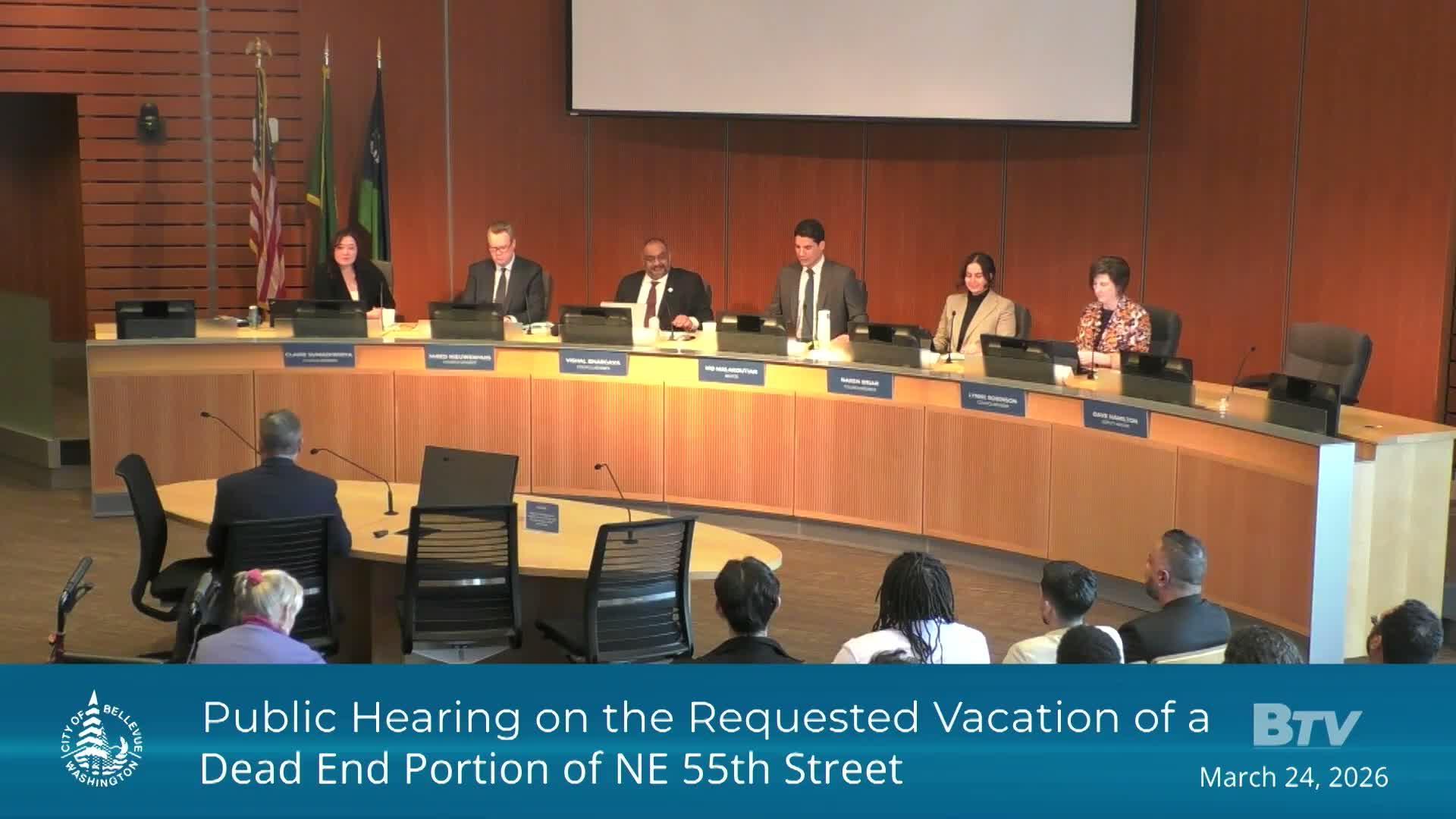
Summary
At a public hearing on Ordinance 6903, supporters urged preserving Old Bellevue's human-scale character while many property owners warned the interim official control could conflict with state laws, raise redevelopment costs and was adopted without owner-specific outreach; staff said the IOC was drafted mindful of state statute but legal challenges remain possible.
Supporters and opponents of a recently adopted interim official control (Ordinance 6903) for Old Bellevue gave contrasting views at a Bellevue City Council public hearing, and councilors pressed staff for legal and implementation clarifications.
Several residents, business owners and association representatives urged the council to keep the distinct, walkable character of Old Bellevue's Main Street. "The character of Bellevue, Old Bellevue, Old Main Street isn't just about preserving a few older buildings," said Alex Kamara, an Old Bellevue resident and member of the Old Bellevue Merchants Association, urging council to "support this very important ordinance" that reinforces pedestrian scale and continuity of local events.
Property owners and developers countered that the IOC, which makes facade-preservation protections mandatory in certain circumstances, could conflict with state law and make redevelopment financially infeasible. "From a basic reading of the ordinance, I would be required to have the facades of my three buildings remain while we construct a modern structure up above," said Bob Perkins, owner of Perkins Property Group LLC, who detailed concerns about increased complexity and cost for the remaining affected parcels. Jesse Clausen, representing a majority of impacted property owners, argued the ordinance "operates as a de facto preservation ordinance" and raised two statutory concerns: he cited House Bill 1576 and House Bill 1293, arguing the IOC lacks an owner-consent provision and includes standards that may be too subjective.
City staff told council they drafted the IOC with state law in mind. Matt McFarland, assistant city attorney, said staff consulted the city's historic resources study and existing code and attempted to honor state requirements, while acknowledging the ultimate legal determination would rest with courts or a hearings board if challenged. "We were fully aware of both of those state laws," McFarland said, adding that whether the ordinance is upheld is not something staff can predict.
Staff described the IOC as a temporary measure intended to preserve facades and add compatibility requirements for redevelopment in Old Bellevue, without changing baseline development capacity. Nick Whipple, code and policy director, said the IOC implements a 50-year threshold and methodologies drawn from the city's earlier historic resources analysis and the National Historic Preservation Act criteria.
Several council members said the underlying policy objective—preserving unique character—is widely shared but criticized the IOC process for limited owner outreach. Council members asked how the IOC defines "historic preservation," whether incentives already exist in the code and whether staff could clarify objective design standards. Staff said the permanent Downtown Livability 2 process will include a fuller land-use code amendment process with stakeholder engagement and could address many of the open implementation questions.
The hearing closed after multiple pro- and anti-IOC speakers; council did not vote on extending or rescinding the IOC at this meeting. Staff and council signaled a desire to refine the approach through the longer Downtown Livability 2 process and to return with engagement and legal analyses before any extension or permanent code change.
What happens next: the IOC remains in place for the specified interim period unless the council acts to extend or amend it. Staff noted the IOC includes a six-month window for review and that further public engagement will occur as part of any permanent code process.