Get Full Government Meeting Transcripts, Videos, & Alerts Forever!
Get email alerts on the Facilities And Property Management topic
No spam. Unsubscribe anytime.
PBK tells Paramount Unified board low enrollment may force middle‑school consolidation; consultant urges portables reduction and community engagement
Summary
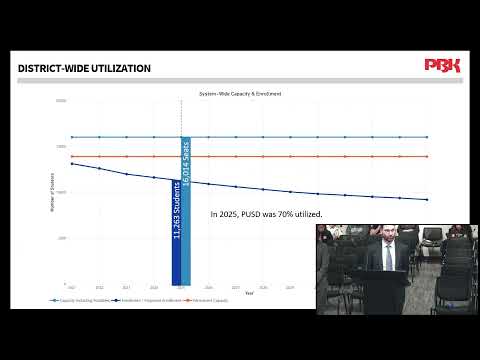
PBK presented a facilities master‑plan utilization study to the Paramount Unified School District board, reporting districtwide utilization falling from about 70% today to a projected 57% by 2034 and recommending steps including removing portables, studying consolidation (especially middle schools), and pursuing long‑term leases or repurposing vacated sites.
Josh Jackson, director of planning at PBK, told the Paramount Unified School District Board at a special meeting that current districtwide utilization—about 11,300 students in roughly 16,000 seats, or roughly 70%—is projected to fall to about 9,200 students (57% utilization) by 2034, a level he called “a red flag.”
Jackson walked the board through his firm’s methodology, which used district enrollment projections and a facilities inventory to calculate capacity with and without portable classrooms. Using Collins Elementary as an illustrative example, he said the campus now shows 688 available seats and 536 students (78% utilization) but is projected to fall to about 459 students (68% utilization) in later projections.
Why it matters: Jackson said underused buildings spread operational costs and staffing across more campuses, weakening resources available to students and making school sites more expensive to maintain. Middle schools were highlighted as the most acute concern: PBK’s analysis shows middle‑school capacity well above current and projected enrollment (about 3,080 students in 5,800 seats, or roughly 54% now, and an estimated 44% by 2034).
Recommendations from PBK included immediately pursuing low‑contention steps such as reducing the number of portable classrooms, seeking partner organizations to occupy underused rooms (Jackson cited in‑school dental clinics as one past example), repurposing buildings for district administrative or wraparound services, and considering grade realignment or consolidation where appropriate. "One of the best things ... is reduce the count of your portables wherever you can," Jackson said.
On consolidation he warned it is often traumatic for communities and urged a transparent, methodical engagement process. Jackson noted Department of Education guidance that typically recommends a 12–24 month community engagement timeline and emphasized assembling an internal team and, where useful, external consultants.
The presentation also addressed options for vacated sites: Jackson recommended long‑term leases to schools, nonprofits or developers (preferably 25‑year terms) over outright sale, flagged potential risks from charter school requests under Prop 39 if a site is left idle, and reviewed the state surplus‑property process—including formation of a public 7–11 committee and Brown Act–governed hearings—if the district pursues a sale.
Board reaction and next steps: Several board members voiced strong support for eliminating portables and targeting middle schools for study. One member said, "We have to consolidate schools. It's time," while others urged a mixed approach that preserves recently remodeled campuses and explores housing or clinics as reuse options. A board member requested a concise, school‑by‑school utilization cheat sheet; PBK and district staff agreed to extract individual school utilization figures from the master plan and provide that report to the board.
Student input: Vargas, the student board member, suggested that a vacated school could become a community clinic to ease access to sports physicals and other services.
Formal actions: Earlier in the meeting the board approved the special meeting agenda on a motion and second; online voting recorded the motion as passing 5–0.
What’s next: District staff and PBK will prepare a condensed site‑level utilization report for the board. Jackson encouraged the board to decide whether to pursue consolidation studies and, if so, to begin a transparent engagement process and assemble an internal/external team to guide the work.
The board then announced it would move into closed session to discuss personnel, anticipated litigation and labor negotiations.