LAUSD sustainability office outlines utility-control center, microgrids and bus electrification plan
Loading...
Summary
The district's Eco Sustainability Office presented plans for a centralized energy and water command-control center, small-scale microgrids and expanded bus electrification, saying pilots and a recent energy contract could lower utility costs and help electrify nearly half the fleet.
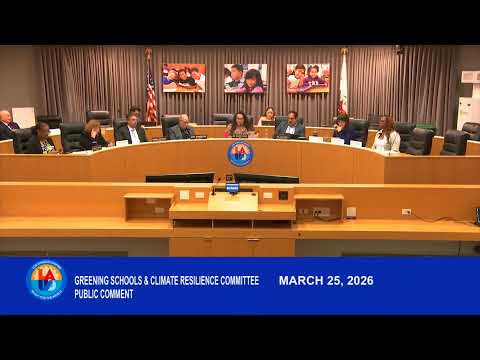
Christos Curacilio, head of LAUSD's Eco Sustainability Office, told the Greening Schools and Climate Resilience Committee that the district is building an energy and water command-control center to centralize telemetry from school utilities and identify anomalies to speed repairs. "This is gonna be a system that we can centralize, look at all of our utilities throughout all of our schools," he said, adding that the program could cut district utility bills by about "20%" once fully implemented.
Curacilio outlined several near-term pilots and investments: microgrids at district sites, a recycled-water expansion at five schools that he said could avoid about 40,000,000 gallons of potable water and a lighting retrofit program accelerated through a Department of Water and Power memorandum of understanding. He said the district has added 41 sites to the LED retrofit effort, with eight projects completed, and estimated the work could yield nearly 5,000,000 kWh in savings and roughly $1,250,000 in utility-account savings so far.
On procurement, Curacilio cited a recently executed contract with energy supplier Constellation, saying the deal is expected to avoid about $3,600,000 in annual costs by locking a lower price per kilowatt-hour: "you can see the contract at 8' per kilowatt hour versus what we're paying today at 12' per kilowatt hour." He said the district pursues such contracts in Edison territory through competitive solicitations when those market conditions are favorable.
Transportation electrification was a major focus. Curacilio described a bus microgrid project that pairs solar and battery storage with nearly 200 charging stations and said LAUSD has already purchased roughly 180 electric buses while decommissioning 180 fossil-fuel and CNG buses. He said pending grants and incentive programs could fund further expansion: "We'll be able to electrify another 242 buses, and at the same time, provide infrastructure for 242 charging stations," moving the district toward an estimated 45% of the fleet electrified.
Committee members pressed for public-facing tracking so savings and greening progress are visible; Curacilio said the office is working on a dashboard and an annual report. On environmental-site testing, he noted a key barrier for greening projects is unknown conditions under asphalt and lead/contaminant testing that can trigger remediation and cost escalation.
The office also outlined climate literacy and student-engagement work, including a network of climate champions and student grants and internships tied to projects. Curacilio said many pilots are intended to scale across the district and that the office aims to finish initial command-and-control and gateway pilots within a year.
Next steps: staff said they will return with implementation timelines, proposed solicitations for electric procurement and updates to public dashboards once pilots yield measurable savings.