Get Full Government Meeting Transcripts, Videos, & Alerts Forever!
Get email alerts on the Tide Recruitment Staffing topic
No spam. Unsubscribe anytime.
TIDE Academy principal and district staff outline recruitment gains and why small‑school staffing raises costs
Summary
TIDE staff described a post‑pandemic recruitment turnaround—open‑enrollment requests rose about 64% after a 2023 revamp—and district HR explained why small schools like TIDE require more per‑student staffing, showing many existing classes well below the 27.5:1 funding ratio.
TIDE Academy leaders and Sequoia Union staffing officials told a community webinar that sustained recruitment efforts produced meaningful increases in interest but that the small‑school model creates unavoidable per‑student costs.
"We revamped all of our marketing and recruitment materials and processes…and the number of open enrollment requests increased by 64%," Principal Simone Kennel said, describing growth after a 2023–24 recruitment overhaul that included shadow programs, additional in‑person events and bilingual outreach materials.
Kennel said the school's location, reliance on district transportation and competition from nearby small private and charter schools affect conversion from requests to enrollments, noting there is attrition after open‑enrollment requests and that enrollment momentum has been disrupted by public discussion of the school's possible future.
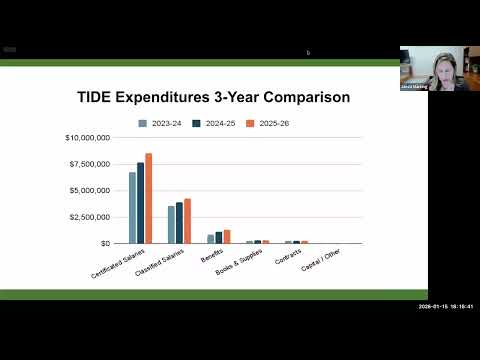
Associate Superintendent Bonnie Hansen gave a detailed explanation of master scheduling and funding. She said the district uses a 27.5:1 ratio to allocate core staffing — "For every 27 and a half students, sites are given 1 full time teacher," Hansen said — and described four funding buckets that together determine how many class sections a site can offer: core site funding (class-size ratio), Category B student‑need funding, Category C program funding (AVID, CTE) and academy allocations. Hansen showed that with 199 students TIDE's core funding equates to roughly 7.2 teachers (about 36 teaching periods) and that many actual TIDE classes are far smaller than the 27.5 target, with examples including advanced courses that had single‑digit enrollments.
Hansen also described how some support and program funds (e.g., certain dual‑credit courses, foundation contributions or Proposition 28 arts funds) can be used for staffing or other program supports but may not fully offset the cost of maintaining core schedules at small schools.
Staff emphasized that the district continues to fund student supports at TIDE (special education, English‑learner supports and advisories) and that some small sections exist by deliberate design to provide access to comprehensive programs and to maintain students' pathway to graduation.
What happens next: district staff will continue recruiting, update public materials, and present enrollment and staffing scenarios at the Jan. 26 board study session. The principal and HR staff invited stakeholders to follow up with questions through the district website.