Get AI Briefings, Transcripts & Alerts on Local & National Government Meetings — Forever.
Oak Grove presents LCAP midyear report and budget advisory update as district faces structural pressures
Loading...
Summary
District staff briefed trustees on the LCAP midyear report showing mixed progress on goals and described a budget advisory committee effort to identify reductions in materials and contracted services and explore revenue options including a parcel tax and bond refinancing.
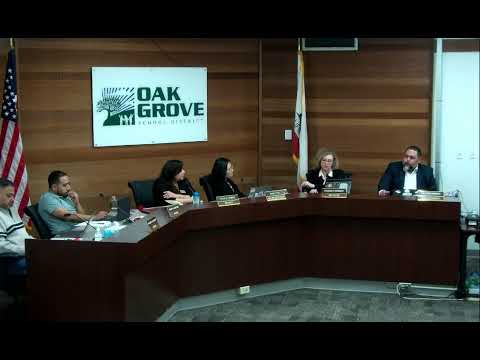
Oak Grove School District staff presented the LCAP (Local Control and Accountability Plan) midyear report Feb. 12 and updated trustees on budget advisory committee (BAC) work focused on non‑staffing categories and revenue opportunities to address projected deficits.
Assistant Superintendent Anna explained that the midyear report (required under Assembly Bill 114) presents updated metrics and expenditure status. District staff said they have spent varied shares of planned LCAP expenditures by goal (for example, Goal 1: 54% spent to date; Goal 2: 39%; Goal 3: 56%; Goal 4: 62%; Goal 5: 47%) and highlighted both gains and areas needing attention: small improvements on SBAC and benchmark data and declines in science scores, increases in long‑term English learner (LTEL) counts (an increase of 43 students in the cohort), and reductions in chronic absenteeism overall but some subgroup increases.
Associate Superintendent Mark Evans reviewed first‑interim budget variances versus the June projections: LCFF revenue estimates rose roughly $1 million from June’s projection; one‑time state monies and federal reimbursement flows (e.g., Medi‑Cal defrays) changed other funding lines; and some previously budgeted one‑time money rolled forward. Evans warned that state timing of a large "settle up" payment could be delayed, which would affect the district’s forecast; staff estimated that a statewide $5.6 billion holdback, if distributed evenly, could amount to approximately $7 million for Oak Grove.
BAC work is focused on the '4,000' materials and supplies codes and the '5,000' contracted services codes, including license agreements and non‑public agency placements that are major cost drivers. Staff discussed near‑term revenue options — boosting attendance recovery, facilities rentals, parcel tax exploration, and bond refinancing — and emphasized the need for parent participation in the BAC and in upcoming town‑hall discussions on a potential parcel tax.
Special education and mental health actions were also highlighted: the district reported transitions of nine students from county placements back to district programs, expanded therapeutic and behavioral supports at several sites, a growing special education parent connection committee, and a team of social workers and interns seeing hundreds of students through wellness check‑ins.
Trustees asked detailed questions about LTEL increases (staff cited cohort effects from COVID‑era early learning disruptions and mobility/absenteeism), site‑level intervention funding (typical allocations of $10,000–$13,000 depending on site), and the mechanics and expected savings from targeting license agreements and contracted services. Staff committed to provide more granular site data on social‑work check‑ins and to continue BAC meetings through spring with recommendations before the May budget revision.