Get Full Government Meeting Transcripts, Videos, & Alerts Forever!
Get email alerts on the Land Development topic
No spam. Unsubscribe anytime.
Residents and builders clash at Lexington County hearing over proposed jump in land‑clearing limits
Summary
A public hearing on Nov. 18 drew hours of testimony as supporters from the building industry backed ordinance 25‑07’s higher disturbed‑acre thresholds (with added BMPs) while hundreds of residents warned the change — and the unexplained appearance of a 75‑acre option in a draft — risks stormwater, Lake Murray water quality, traffic and schools. The council did not vote; additional readings and Planning Commission review are pending.
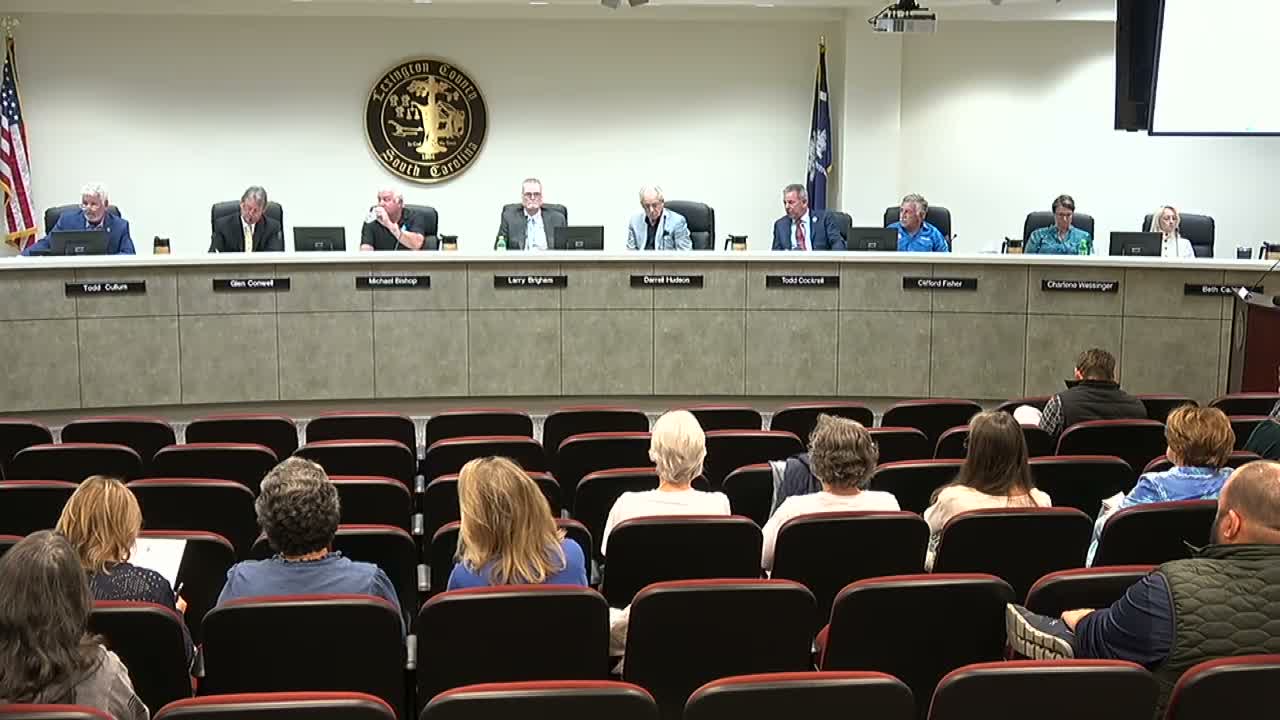
Lexington County held a lengthy public hearing on Nov. 18 over ordinance 25‑07, a proposed amendment to the county’s land development manual that would raise allowable disturbed acreage for residential projects and change the review process for larger sites.
County staff described the proposal as a measured, process‑driven change. Team development director Derek told the council the text would raise the baseline residential disturbance threshold modestly (from 20 to 25 acres) and allow up to 50 acres with an expanded master plan and a disturbance stabilization agreement that includes additional best management practices (BMPs). He said projects over 50 acres — and up to 75 in the draft language — would require review by the Stormwater Advisory Board and potentially by council after Planning Commission consideration.
Supporters from the building industry said the change would speed construction and reduce repeated mobilizations, which they said lowers costs and shortens exposure of sites to weather. "When a project is submitted through the process for permit, the county applies its ordinances and grants its approval for the amount of land disturbance involved," Shane Alford told council, arguing that completing a site more quickly reduces risk from weather and repeated disturbance. Builder representatives emphasized that the draft requires additional BMPs, stabilization benchmarks (including 80% stabilization before expansion) and financial assurances such as letters of credit or cash surety for disturbance stabilization agreements.
Developers said those safeguards would allow crews to put detention ponds and final grading in place earlier and stabilize the site sooner. "This is how it will better the community," said Corey Swindler, a developer. Emily Martin, speaking for local builders, said aligning disturbance allowances with neighboring counties and requiring stronger erosion controls would benefit both neighborhoods and the environment.
But opposition from residents was extensive and impassioned. Dozens of citizens said the draft’s step to allow "75 acres or more" appeared in a recent posted document without clear explanation and demanded transparency. Speakers cited repeated stormwater violations, erosion concerns, and threats to Lake Murray — the county’s major water resource — and to neighborhood character, tree canopy and wildlife. "Tripling the land‑clearance allowance does not align with fostering a quality environment," said Jim Braun, urging council to halt the proposal and call for more study. Multiple residents raised classroom overcrowding and infrastructure strain as local consequences of faster, larger‑scale subdivision development.
Several speakers asked why the 75‑acre language appeared in the most recent draft when earlier collaborative discussions between staff, developers and grassroots groups had proposed lower maximums (a 50–60 acre upper band in earlier drafts). "Why increase clearing from 20 acres with allowances up to 60 all the way to 75 when the county hasn't proven it can manage what we have?" asked Laura Touchberry, representing a local grassroots group that participated in earlier stakeholder meetings.
Council members pressed staff for technical clarifications during the hearing, including whether the 60‑acre threshold mentioned in prior texts applied to commercial versus residential projects and what triggers Stormwater Advisory Board review. Staff repeatedly clarified that residential and commercial thresholds differ, that the expanded master plan process adds five additional BMPs for qualifying projects and that the Stormwater Advisory Board would review projects above the staff‑level threshold.
The hearing included a mix of written portal submissions and in‑person speakers; staff noted online counts that included duplicates and misfiled responses. The council did not vote on ordinance 25‑07 at the Nov. 18 meeting. Staff said the proposal will still require further public review: Planning Commission consideration and at least two additional council readings before adoption.
What happens next: Council will forward the text for Planning Commission review and schedule further readings; the draft’s 75‑acre language and the procedural questions raised by residents are likely to remain key points in upcoming deliberations.