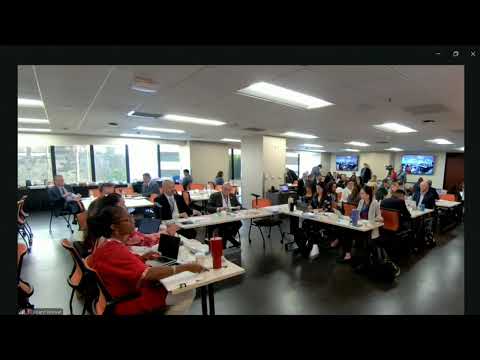
LAUSD retreat finalizes ambitious literacy, numeracy, science and college/career targets; SEL measurement deferred for further review
Loading...
Summary
At a board retreat, Los Angeles Unified staff and board members agreed on aspirational district targets for literacy, numeracy, science and college/career readiness to anchor the 2026'1030 strategic plan; the board asked staff to return with options before finalizing SEL measurement tools.
The Los Angeles Unified School District used a board retreat session on March 31 to finalize target directions for the district's 2026'1030 strategic plan. Board members and staff coalesced around ambitious targets for literacy, numeracy, science and college-and-career readiness, and agreed to further develop an implementation plan; the board requested more work on how to measure social-emotional learning.
Staff presentations, led by Dr. John Fullerton (USC) and district staff, recommended numerical targets for literacy and numeracy based on "distance from standard" metrics. Staff said achieving the literacy goal could require roughly 2.9 points of average annual growth in grades 3'5, an uncommon pace seen in a small number of districts statewide. For numeracy, proposals included a multi-year growth path with some grade spans needing more rapid gains.
On science, the board supported the staff recommendation to set the goal at an average at-standard outcome in grades 5 and 8, while several members emphasized the need for hands-on instruction time and teacher supports to reach that target.
For postsecondary outcomes, staff proposed a two-number approach: one measure for A-G completion (college readiness) and a second for career readiness (CTE pathway completion or JROTC). The proposed aspirational target was 85 percent of the graduating cohort being college and/or career ready, with at least 70 percent being college ready under the A-G standard. Board members debated label wording ("postsecondary readiness" vs. "college and career readiness") and measurement mechanics; they ultimately provisionally adopted a "college and career readiness" framing while asking staff to refine measurement details.
The social-emotional learning (SEL) goal prompted the most discussion. Staff proposed piloting a new pre/post diagnostic intended to measure application of SEL competencies (not just attitudes or mindsets). Board members raised concerns about adding another assessment, validity and reliability, report-card alignment and how to measure application rather than survey responses. Members asked staff to return to the Committee of the Whole with a curated menu of options, sample items and evidence from schools already using SEL tools.
Next steps: staff will draft the updated strategic plan and operational implementation plans based on the agreed targets, present SEL measurement options and sample diagnostics to the Committee of the Whole, and bring a draft strategic plan for board and community review in June.