Get Full Government Meeting Transcripts, Videos, & Alerts Forever!
Get email alerts on the Iep Participation topic
No spam. Unsubscribe anytime.
LAUSD committee highlights growth in student participation in IEP meetings and showcases school practices
Summary
District special education staff reported rising student involvement in IEP meetings and described tools — including an "IEP passport" and a participation matrix — while principals and students showed classroom examples of how nonverbal and young students can meaningfully join their IEPs.
Carla Griego, chair of the Los Angeles Unified School District special education committee, opened the meeting by framing student participation in Individualized Education Program meetings as a district priority that affects roughly 70,000 students served by the division of special education. She introduced presentations from central office staff and three school sites to show how students are being invited into IEP conversations.
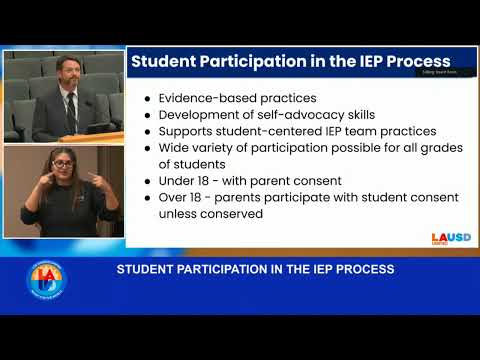
Dr. James Coutts, coordinator for moderate, severe and least-restrictive-environment programs, told the committee the district uses a "matrix of participation" to tailor invitations and participation options by age and need. He said preliminary signature-based counts show about 8,000 students participated in 2022–23 and that through early March 2025–26 the district had recorded more than 13,300 student participations, putting the district on pace to meet or exceed last year’s 16,842 participants. "We moved from one-fifth or one-sixth all the way to one-third possibly in just a matter of years," Coutts said, describing the increase as evidence the approach "works".
The presentations emphasized that participation does not mean assent to services. Coutts explained that for students under 18 participation requires parental permission and that when a student is 18 and not conserved, the student must agree to parental involvement. He also said the district is measuring the minimum participation by whether a student signs that they attended the IEP meeting as part of the participation metric.
School-level presenters showed examples of how to include students of different ages and abilities. At Anatolia Elementary School, assistant principal Eunice Mikasa described strategies for nonverbal students: therapists and providers demonstrate an OT activity or a science project while the child shows the family what they do in class. "We have students come in and sometimes they introduce the IEP team to their families," Mikasa said. The school’s principal said Anatolia aims for 100% participation over time.
At Sonia Sotomayor Magnet, assistant principal Felicia Montes and bridge coordinator Alma Garcia described an "IEP passport," a concise summary of accommodations that students carry and can show teachers. Student Alexa Carrillo, an 11th-grader, credited participation with helping her understand supports and advocate for accommodations: she described using her passport to show a teacher what she needs and then following up with her case manager when supports were not implemented.
John Gomez, a district speech-language pathologist, described gains for students who stutter when they are invited into IEPs. He urged consideration of a dedicated stuttering-support role that was cut two years earlier and said including students can change the meeting language from acronyms to plain explanation, which he argued improves outcomes.
Committee members and parents pressed for clarity about referral processes and training. One member asked why middle school participation rates appear lower; Coutts said differences in grade-span sizes partly explain the discrepancy and that the jan–June IEP season typically adds several thousand participations. District staff described a toolkit, region-level meetings and planned workshops for families and staff to improve consistency across schools.
The committee did not take formal votes on these items. Members asked staff to continue outreach and to bring recommendations to the division and board; Griego said staff would compile recommendations and present them to the division of special education and the board ahead of the May meeting.
The presentations and parent testimony underscored implementation variability: several parents said their children had not been invited to IEPs, or had been offered remote-only meetings, and called for more in-person outreach, clearer notifications and consistent school practices. District staff said they will expand training and share resources but emphasized implementation must be tailored to each school's students and capacity.
Next steps: the committee expects to continue discussion at the next meeting and develop workshops and toolkits to scale student participation practices.