Get Full Government Meeting Transcripts, Videos, & Alerts Forever!
Get email alerts on the Board Governance topic
No spam. Unsubscribe anytime.
Mesa City Schools trustees review leadership‑style survey, affirm collaborative culture at governance workshop
Summary
Trustees used a pre‑meeting survey to assess board leadership styles, worked in small groups on five governance questions, and reported a shared view that the board is collaborative and vision‑oriented while seeking clearer measurable outcomes. A community member urged focus on core academics.
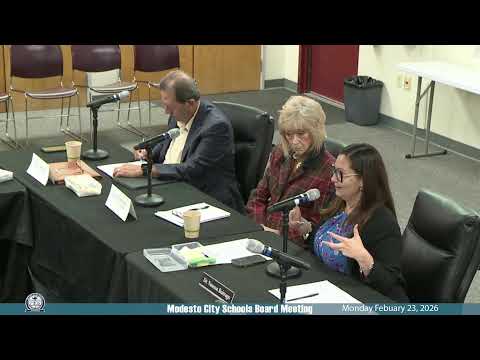
Mesa City Schools trustees met for a governance workshop on Feb. 23, 2026, where a board‑wide survey and facilitated activities were used to examine how trustees lead and how that leadership affects decision making. The session included breakout groups, report‑outs, a short leadership video and a public comment near the end of the meeting.
The superintendent opened the evening and introduced consultants from Leadership Associates. Dr. Sally Frasier, a consultant who led the session, described the meeting as developmental rather than evaluative and walked trustees through the packet, which included an executive summary and the original survey instrument. "A keystone allows all parts of a structure to work together to support the whole," Frasier said, using the keystone metaphor to describe the board's role in governance.
Trustee Maestas read the executive‑summary takeaways aloud: "No single style is sufficient on its own. Effective governance requires the ability to shift leadership approaches based on the organization's need, maturity and environment," he said. Trustees then split into small groups and addressed five guided questions about perception alignment with staff and community, whether collaborative culture slows decisions, crisis response, vision versus measurable outcomes, and whether lack of autocratic tendencies creates ambiguity about leadership.
Report‑outs showed broad agreement that the board sees itself as collaborative, service‑oriented and vision‑driven, while acknowledging uncertainty about whether staff and portions of the community perceive the board the same way. On the question of timely decision making, groups said collaboration sometimes lengthens meetings but does not generally prevent decisions; members cited adherence to the Brown Act as a reason discussions take place in public meetings. Several trustees recalled shifting toward more directive approaches during urgent fiscal moments — for example during COVID budget decisions — while still emphasizing that they sought to act with compassion and planning.
On accountability, trustees said they want clearer measurable outcomes tied to vision priorities such as students' reading, writing and math scores and that they are increasingly requesting quantitative and qualitative data to track progress. Dr. Frasier and other facilitators urged trustees to maintain stability where the district's vision is producing results and to keep working on alignment, integration and culture across the system.
A brief 39‑second video featuring Molly Grisham — who said, "a leader is a person of influence who uses their influence for good" — was played twice and drew positive reactions from trustees, who said it reinforced the board's emphasis on modeling behavior for students and the community.
During public comment, a longtime community member urged trustees to prioritize academics and cautioned that trustees "are elected too" and are a political body that the public watches closely; the speaker also expressed concern that the board sometimes defers too much authority to the superintendent. The board then moved to adjourn; Vice President Daley made the motion, Trustee Maestas seconded it, the board approved by voice vote and the meeting ended.
The workshop sets the stage for the superintendent evaluation the board expects to undertake next; facilitators and trustees said the session was intended to strengthen norms and shared understanding ahead of that process. No formal policy votes or budget actions were taken at the workshop.