Get Full Government Meeting Transcripts, Videos, & Alerts Forever!
Get email alerts on the Land Use Zoning topic
No spam. Unsubscribe anytime.
Residents split over proposed zoning changes in Lexington County public hearings — density, schools and watershed dominate comments
Summary
At three public hearings July 29, residents and developers debated proposed zoning amendments (ordinances 25-06, 25-11 and 25-12). Supporters emphasized protecting watersheds and quality of life; opponents warned higher lot-size minimums and rules will increase housing costs and worsen sprawl; many speakers pressed for cumulative school-concurrency accounting and better coordination with the Town of Lexington.
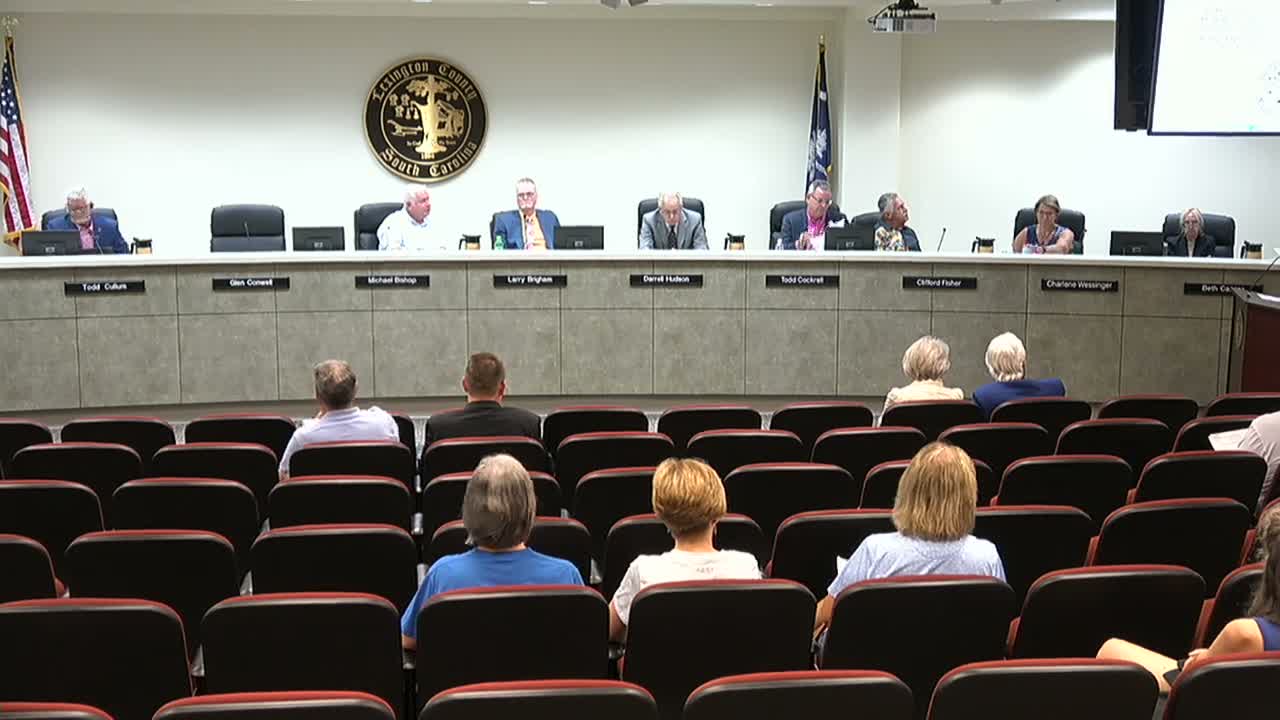
LEXINGTON COUNTY — Lexington County held three linked public hearings July 29 on proposed zoning and open-space amendments that would change how residential density, waterfront development and minimum lot sizes are regulated in central Lexington County.
Community Development Director Robbie Derek summarized the package: ordinance 25-06 would amend the zoning code for certain residential-detached limited land uses, incorporate those uses into the county’s concurrency review process, remove ponds from gross-acreage density calculations, and cap townhomes and similar uses at six dwelling units per exact acre in some categories. Ordinance 25-11 would establish a Central Lexington County overlay (to align county and Town of Lexington rules), cap townhomes there at four units per exact acre, set a single-family minimum lot size at about 10,890 square feet, require traffic impact studies to use school-peak traffic data and create a waterfront protection area with 30-foot building-height limits for certain segments of Lake Murray and the Saluda River. Ordinance 25-12 would update landscape and open-space rules to be consistent with the overlay and apply a sliding scale for open space based on lot size.
Speakers were sharply divided. Proponents, many of whom asked the county to align with the town and to protect the Lake Murray watershed, argued lower density reduces runoff and preserves tree canopy, open space and quality of life. “Water is life,” one supporter said, urging larger lots and more green space to prevent stormwater runoff into the lake. Several supporters urged the town of Lexington to adopt consistent standards so annexation cannot be used to “leapfrog” lower standards into sensitive areas.
Opponents — including developers, engineers and some builders — said the proposed minimum-lot increases and other changes would raise infrastructure and housing costs, reduce attainable housing and push development farther into rural areas. Developers noted that thicker road bases, longer utility runs and stormwater systems increase per-lot costs and warned that a quarter-acre minimum would likely put many entry-level houses above intended price points. A civil engineer and other industry speakers urged council to avoid repeatedly using the pending-ordinance doctrine at early stages and recommended more collaborative negotiations with the development industry to incentivize desired forms of growth.
Education and emergency services were recurring themes. Multiple speakers said school-capacity calculations need to be cumulative across approvals, not assessed project-by-project; some cited Lexington High’s pipeline of lots and said concurrency questionnaires and committee reports did not reflect cumulative seat demand. Several residents described long EMS response times and concerns about adequate fire staffing in rapidly growing parts of the county.
Council heard technical and procedural requests: several commenters urged delaying second-reading votes until the Town of Lexington’s related zoning proposals move forward so the two bodies act in alignment; others urged that staff share data from schools, law enforcement, EMS and DOT so council can weigh infrastructure impacts accurately.
Council did not take final votes on the three ordinances at the July 29 hearing; the public record for the hearings is now closed and staff follow-up is expected. Comments from the night show the policy tradeoffs: watershed protection and lower density to preserve quality of life versus land-use rules and infrastructure costs that affect housing affordability.
Next steps: Council will consider the hearing record, staff technical follow-ups (school capacity and infrastructure cost estimates) and potential revisions in future readings. The county clerk recorded the hearing testimony and the council adjourned after completing the public-comment session.