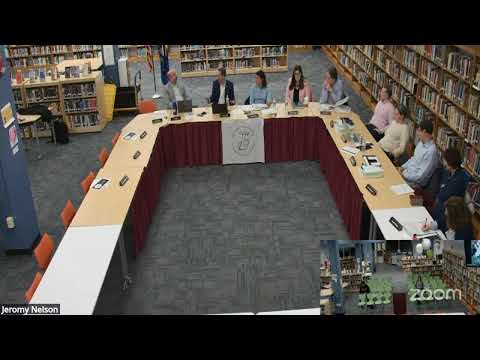
Region 15 board hears budget presentation warning that health insurance and special education costs are driving next year’s increase
Loading...
Summary
Superintendent Joshua Smith told the joint finance meeting that rising health-insurance and special-education costs are the largest budget pressures for Regional School District 15; board members debated risk tolerance, potential targeted cuts and smoothing the district's allocation formula ahead of a referendum and follow-up meeting on April 6.
Joshua Smith, superintendent of Regional School District 15, told a joint finance meeting that rising health-insurance and special-education costs are the biggest threats to next year's budget.
"This is the chart that keeps me up at night," Smith said, referring to a slide showing recent insurance trends and a district survey he described as averaging a 44% increase in health-insurance costs among 70 responding Connecticut districts. He said the district's own modelling suggests that, if current trends continue, insurance spending could grow faster than salary spending within about a decade.
Smith framed the proposal by explaining the district moved from a net- to a gross-budget presentation to make revenue sources and allocations more transparent. He said the technical budget increase is 5.48 percent while towns see a 5.3 percent change on the towns' budgeting metric, and identified three main cost drivers: salaries, benefits and transportation.
On special education, Smith and staff described a strategy of bringing some programs in-house to avoid very high outplacement tuition. "By bringing programs in-house, even if we hire 2 staff members and spend $50,000 to build a program, it's still way more efficient than sending students out," Smith said, noting that one in-house program prevented several outplacements. Staff cautioned, however, that precise long-term savings are difficult to quantify because each student's needs, transportation and tuition rates vary.
Board members pressed staff on specific cost drivers and alternatives. One member asked whether the district had aggressively shopped health-insurance stop-loss or carrier coverage; staff said they competitively bid renewals and that a move to the state plan would likely be more expensive than the district's current self-insured arrangement. Staff also noted Anthem currently provides the district's stop-loss coverage above roughly $125,000.
Members debated risk tolerance built into the proposed number. Several trustees said they broadly support the 5.48 percent figure as a careful balance given market volatility and the upcoming referendum on a school construction project. Others asked staff to prepare options to get the number 'down nearer 4.50 percent, recommending a short list of tradeoffs for the April 6 follow-up (examples discussed included delaying or reconfiguring a social-worker hire, reconsidering a full-time facilities director versus project-based or reimbursable contract work tied to the referendum, and targeted reductions to contingency or maintenance lines).
Board members repeatedly returned to reserves and long-term exposure. Staff noted Regional School District 15 has grown its capital and reserve lines in recent years but remains low relative to many peers and that reducing the contingency or special-ed reserve would shrink the district's margin to handle unexpected high-cost special-education claims.
Transportation costs were explained as another rising line item: staff said renegotiated contracts and higher labor rates for private bus drivers (Teamster contract terms) are contributing to a transportation increase projected at about 7.3 percent.
There were no public speakers during the hearing portion. The board recessed briefly by voice approval and later adjourned after agreeing to continue budget deliberations at a finance meeting on Monday, April 6, ahead of the full Board of Education vote on the 2026-27 budget.
What happens next: staff will provide the board with the detailed proposals and a scenario list for how specific reductions (and their operational impacts) could lower the proposed increase, and board members will continue discussion on April 6 before the formal budget vote and any referendum-related outreach.