Get Full Government Meeting Transcripts, Videos, & Alerts Forever!
Get email alerts on the Strategic Plan topic
No spam. Unsubscribe anytime.
Superintendent outlines midyear progress on family resource centers, recruitment, UDL/restorative practices and common assessments
Summary
Superintendent McDuffie and district staff presented midyear progress on family resource centers and community schools grants, expanded recruitment events and hiring improvements, professional development combining universal design for learning with restorative practices, and rollout plans for district learning cycles and common assessments tied to state standards.
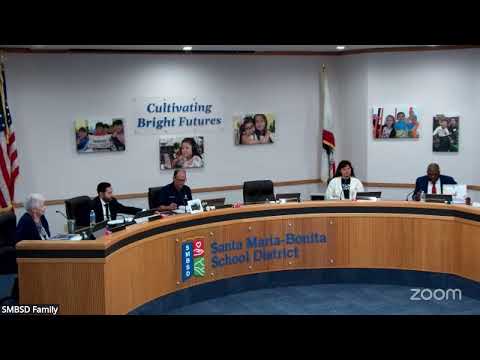
Superintendent McDuffie and district leaders presented a midyear strategic update summarizing progress across four strategic priorities: family and community partnerships, recruitment and retention, inclusive teaching practices, and instructional alignment.
On family resource centers and community schools, staff said competitive grants supported implementation district‑wide and highlighted partnerships including Allan Hancock College offering ESL courses at family resource centers. Early outcomes included increased family engagement and referrals to housing, health and other community supports.
A human resources update said the district expanded recruitment beyond regional markets, improved hiring efficiency at classified job expos (a reported 65% hiring rate from attendees at recent events), and is using targeted outreach and early offer letters. Staff reported collecting survey data to refine recruitment channels and to use teacher residents/substitutes to facilitate teacher release for professional learning.
Presenters described combining universal design for learning (UDL) and restorative practices in professional development to remove both structural and social barriers to learning. The district said counselors engaged in monthly restorative practice training and teachers received PD on learner variability, de‑escalation, UDL lesson design and restorative engagement strategies.
On curriculum and assessment, staff described year‑long matrices with five learning cycles per year and 25 focus standards, the creation of district common assessments aligned to the CAASPP, and plans to implement learning cycles and common assessments in 2026–27. Staff emphasized teacher‑driven design and district‑wide common assessment reflections to monitor proficiency.
Board members asked questions about family resource center coverage at all sites, the time burden on teachers for this work, and how the new assessments will align to existing measures such as NWEA. Presenters said the work is teacher‑driven, uses scheduled teacher release days and teacher residents for subs, and that committees will review assessment overlaps before adding measures.
The board acknowledged receipt of the midyear update; staff said many of the initiatives are ongoing and will be refined each year.