LA County Public Works outlines $126.3 million stormwater capture project at Bassett High School
Loading...
Summary
LA County Public Works presented plans for a $126.3 million regional stormwater capture and groundwater recharge project centered at Bassett High School that would recharge the San Gabriel Basin, serve roughly 1,300 families a year and create a leased passive recreational area. Officials described three construction-area alternatives, traffic-closure plans and a community meeting ahead of construction.
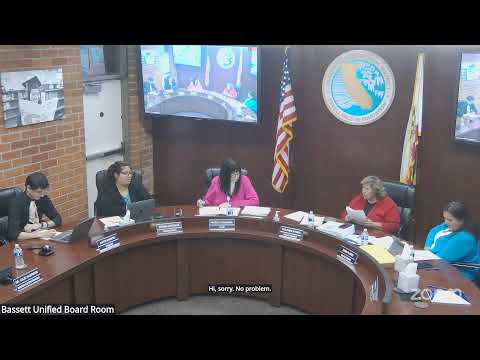
Donna Tran of LA County Public Works told the Bassett Unified Board of Education on March 24 that a regional stormwater capture project, centered on an infiltration gallery at Bassett High School, aims to recharge the San Gabriel Basin and provide water for up to 1,300 families of four per year.
Tran said the project, which planners estimated at $126,300,000, "meanders through multiple jurisdictions" (Baldwin Park, Industry, La Puente, West Covina and unincorporated L.A. County) and will intercept flows from existing storm drain lines into a pretreated infiltration gallery at Bassett High School. She said the project also includes a leased passive recreational area with bioswales, drought-tolerant plantings and an outdoor auditorium meant for outdoor learning and community use.
The presenters said major funding has been secured, including Measure W safe, clean water funds and a $30 million contribution from Caltrans. Tran warned that if Measure W funds are not expensed in the next fiscal year the project could lose roughly $30,000,000 of that allocation. County public works representatives also said local cities and county funds are partners in the financing.
Project timing and delivery: Public Works said design is anticipated to be complete in April 2026 and that the district will use a CMAR (construction manager at risk) delivery method; a contractor has been procured and construction is planned to start later in the year, with construction lasting a little over three years under the current schedule. In presentation slides, staff identified an October start and noted construction sequencing to limit concurrent closures.
Construction-area alternatives: Project staff described three on-site alternatives. Alternative 1 is the most efficient for construction (shortest duration, roughly 18 months) but uses the full sports field footprint and would disrupt two sports seasons; alternative 2 keeps fields available but extends construction to about 30 months and increases staging on neighborhood streets; alternative 3 is a hybrid (roughly 12 months of larger-footprint work followed by about 9 months on a reduced footprint) intended to balance school and community impacts.
Traffic and staging: The project team walked trustees through a proposed closures map and said most intersection restrictions would be short (48-hour closures scheduled over weekends), while some locations would require longer, full closures (for example, a two-month full closure at one diversion location). The team said closures will be coordinated with Baldwin Park and the City of Industry and that residents will retain local access; construction staging plans include off-street staging on the field where possible.
Air quality and CEQA: Trustees and residents pressed on dust and air-quality risks near school activities. The presenters said the work is subject to the California Environmental Quality Act review and that construction specifications will include dust-control and mitigation measures; they noted air-quality monitoring and construction-hour restrictions to reduce exposure during student activity times.
Outreach and next steps: Public Works said it plans a community meeting on April 14 (initially planned for Bassett Park; presenters said they could move the meeting to Bassett High School if the district prefers) and will mail flyers to residents within a one-mile radius of the diversion points. The presenters asked the board for guidance and said they would return to the April 21 board meeting seeking consensus or possible action on a preferred construction alternative.
Board members praised the project's water-conservation goals but emphasized communication, coordination for school pickup/dropoff periods, emergency-evacuation uses of the fields and close outreach to nearby churches and schools. Several trustees urged minimizing construction during peak school activity days and ensuring clear resident notification about closures.
The district did not vote on a construction alternative at the March 24 meeting; staff said they would bring consent language or a motion at a subsequent meeting after additional outreach and internal coordination.