Get Full Government Meeting Transcripts, Videos, & Alerts Forever!
Get email alerts on the Finance topic
No spam. Unsubscribe anytime.
District presenter outlines EAV scenarios, restricted levies and staffing implications
Summary
At a Bethalto CUSD 8 board meeting, the district presenter reviewed Truth in Taxation estimates, showing an 11‑year EAV growth trend and a 12% 'outer limit' scenario that would produce an estimated EAV of $359 million; board members discussed local tax burden, security investments and the potential impact of waning federal grants.
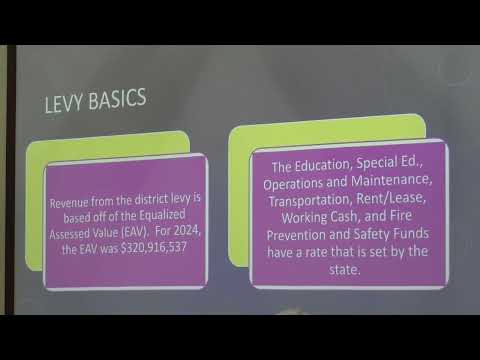
The district's finance presenter reviewed the annual Truth in Taxation report to the Bethalto CUSD 8 Board of Education, laying out how the district estimates equalized assessed value (EAV), how state equalization multipliers and exemptions affect reported values, and which levies are restricted to specific uses.
"There is no penalty to guess high," the presenter said, explaining that the district estimates an "outer limit" 12% growth scenario that would show an EAV of about $359,000,000, while the actual rates will be applied to the actual EAV the county certifies. The presenter emphasized that restricted levies — bond and interest, IMRF and Social Security/Medicare, and the tort/liability fund — are calculated separately and support long-term obligations and safety investments.
The presentation traced an 11‑year trend of rising EAV and showed recent spikes around 2020. The presenter said the levy rate has fallen from a high of $5.31 in 2018 to $4.49 last year and that, depending on final EAV and the state multiplier, the levy rate should fall by about 5–10 cents this year.
Board members framed the numbers as a shared community responsibility. One board speaker noted that districts with heavy industry (for example, Granite City with U.S. Steel and Roxana with refineries) have different tax bases and that Bethalto relies more on residential property values. Members also raised the prospect of reduced federal funding for programs such as Title I and special education and said the district will need to absorb any cuts into the operating budget.
The presenter outlined how restricted funds are used: the tort fund finances school-resource officer salary, athletic trainers, security equipment and legal settlements; bond and interest pay debt service on past capital projects; and retirement levies cover IMRF and similar obligations. The presenter also showed three-year expenditure comparisons and said FY23 expenditures were just over $31 million as federal ESSER and ARPA funding wound down.
Board members asked questions about enrollment trends, staffing and planned safety investments; the presenter said a district-wide camera and access-control system is on the horizon and framed that as part of maintaining community appeal and student safety. The board did not adopt a tax rate at the meeting; the presentation was to inform upcoming certification and levy-setting steps.