Get Full Government Meeting Transcripts, Videos, & Alerts Forever!
Get email alerts on the Ethics topic
No spam. Unsubscribe anytime.
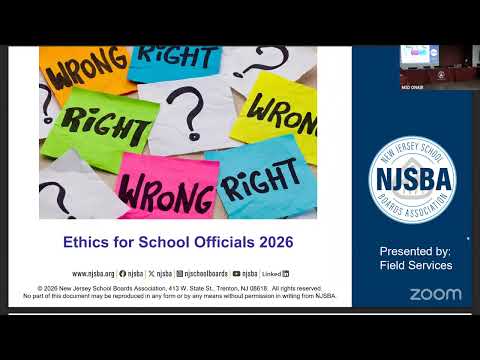
NJ School Boards Association presenter gives extended ethics refresher to Morris School Board
Summary
A presenter from the New Jersey School Boards Association reviewed the School Ethics Act, disclosure and recusal rules, and real-case examples of violations — urging board members to use advisory opinions and avoid actions that could create an appearance of impropriety.
A presenter from the New Jersey School Boards Association addressed the Morris School Board on the School Ethics Act and practical steps board members should take to avoid conflicts of interest.
The presenter, identified in the meeting as Paul, told the board, “I am not an attorney,” and said the association’s guidance is advisory rather than legal counsel. He described the School Ethics Act (1991), mandatory trainings for new and returning members, and the requirement that officials file annual financial-disclosure statements that list sources of income rather than amounts.
Why it mattered: the presenter walked through recent cases to show how commonplace lapses — from accepting vendor overruns to using board email for campaign or advocacy messages — can create the appearance of impropriety that triggers reprimands, censures, suspensions or, in extreme cases, removal.
The presentation included examples the presenter said had led to formal discipline: a board member publicly discussing a bargaining position that undermined negotiations; use of a board email account to solicit participation in a parent association; and a member advocating for hiring decisions that should come through superintendent recommendations. The presenter explained the four levels of commission discipline — reprimand, censure (board-adopted resolution), suspension, and removal — and outlined the “advice of counsel” defense if certain conditions are met.
The presenter recommended routine practices to reduce risk, including: filing accurate disclosures on time; recusing from votes when a direct benefit to the member or an immediate family member exists; avoiding the word “we” in public remarks that could be read as speaking for the board; and using an advisory-opinion request to the ethics commission when uncertain. He also urged caution with social media, volunteer roles that could appear to confer a benefit, and the use of board channels for personal campaigning.
The presenter offered to share PDFs and advisory resources after the meeting and invited questions from board members.
The board did not take formal action on the presentation; it was provided as training and a resource for members ahead of future governance decisions.