Get Full Government Meeting Transcripts, Videos, & Alerts Forever!
Get email alerts on the Ethics topic
No spam. Unsubscribe anytime.
Board counsel reviews School Ethics Act, warns of conflicts and 6‑month complaint deadline
Summary
Board attorney Mark Zidemer delivered the annual School Ethics Act presentation, outlining who the law covers, the code of ethics for board members, the six‑month statute of limitations for complaints, advisory opinions, remedies, and indemnification rules.
The board received its required annual briefing on the New Jersey School Ethics Act from board attorney Mark Zidemer, who reviewed the statute's scope, key code provisions, complaint procedures, and remedies.
Zidemer told the board the Ethics Act is codified in Title 18 of the New Jersey statutes and said it establishes prohibited acts and a separate code of ethics that applies specifically to board members. "The New Jersey School Ethics Act is a law. It's set forth in title 18 of the New Jersey statutes," he said.
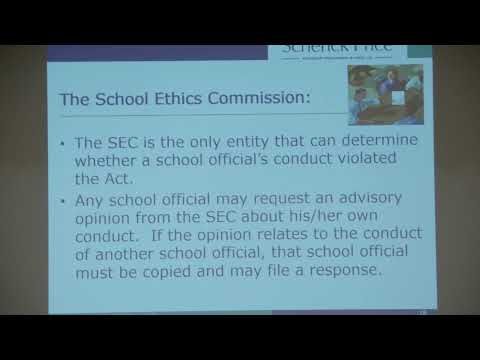
He stressed avoiding both actual conflicts and the appearance of impropriety; board members should refer complaints and operational requests to the superintendent rather than taking direct action. Zidemer explained that anyone can file an ethics complaint but that the filing window is time‑barred after six months: "There is a time period, and the time period is 6 months." He also described available sanctions (reprimand, resolution read at a meeting, suspension, removal) and explained that advisory opinions and guidance can be requested from the School Ethics Commission.
Zidemer noted indemnification protections under New Jersey law: board members are entitled to a defense for actions arising from the performance of their duties and the board typically provides legal representation for administrative ethics matters; criminal matters require exoneration to trigger indemnification.
The presentation reinforced that the board is a policy‑making body and should avoid involvement in day‑to‑day administration; Zidemer urged board members who face potential conflicts to seek advisory opinions or legal advice to avoid procedural or ethical missteps.