Quincy School District reports 454 students in special education; LRE rate reaches 88.4%
Loading...
Summary
District special education staff told the board the program serves 454 students, exceeded an LRE goal with 88.4% of students in the least restrictive environment, and outlined changes ahead including a statewide move away from the discrepancy model toward growth-based measures and new transition/18–22 initiatives.
Quincy School District officials told the board at a regular meeting that 454 students are currently served in the district’s special education program and that 88.4% of students are now placed in LRE 1, the district’s metric for time spent in the least restrictive environment.
The report, delivered by the district’s special education staff (Speaker 6) with classroom and program details from Lisa Martinez (Speaker 7), outlined staffing levels, service models and an impending statewide assessment policy change that will replace the discrepancy model with student growth and patterns-of-strength measures in the 2028–29 school year.
District staff said the program’s scale requires a mix of certificated staff (21) and 48 classified staff plus contracted specialists such as speech-language pathologists, teachers for vision and hearing impairments, occupational and physical therapists, a nurse for medically fragile students and BCBAs to support behavior plans. “We have 454 students that are currently in our program,” Speaker 6 told the board.
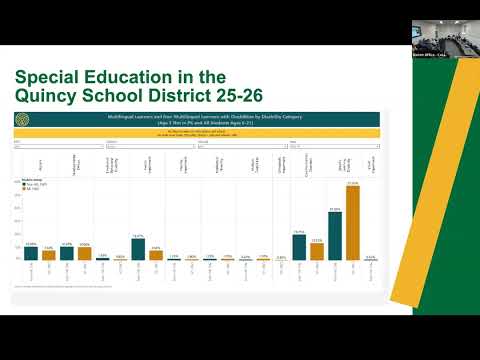
Officials flagged one notable local pattern: a much higher share of students identified with a specific learning disability than the statewide average. Speaker 6 described the district’s SLD identification at nearly 50% in that category versus about 30% statewide and said staff are reviewing whether language differences, limited prior instruction or assessment methods contribute to that gap. The speaker explained the discrepancy model used for SLD identification and said Washington schools will move away from that approach in favor of growth-based measures.
Lisa Martinez read a letter from teacher Sandra Garcia that described inclusion as ‘‘full co-teaching’’ and cited classroom gains and awards as evidence that the model is working for some students. Martinez also outlined a continuum of services now in place: developmental preschool (which this year includes speech-only students), life-skills classes, replacement core classes for reading and math, supported classes in general education, targeted support/grad-success classes and an expanded ‘‘limited support’’ model.
On outcome measures and next steps, the district reported an LRE 1 rate of 88.4%, exceeding an earlier 80% target. Speaker 6 said the district will refine its service matrix, improve transition planning and expand post‑secondary outcome tracking: a recent survey showed 46% of graduates were engaged in college or work activities, a figure staff called low and a priority for improvement. The district is also pursuing pre‑employment transition services and paid internships, and planning an 18–22 program focused on independent‑living and work skills for older students.
Board members asked about whether state pressure exists to reduce special education counts; Speaker 6 said the district is not ‘‘over qualifying’’ (noting a 13% overall special education rate) and emphasized that Washington’s policy direction since 2017 has prioritized inclusion while still recognizing placement decisions must be individualized.
The board heard about family engagement efforts (four family nights for students with disabilities, two preschool family nights) and community partnerships, including a Department of Developmental Disabilities presentation at a recent family event. The superintendent and staff said the district will continue to monitor identification rates, refine MTSS practices, and work with families and teachers as the state’s assessment policy shifts.
The board did not take action on the report; staff listed the items as updates and next‑step efforts to return with additional data and refinements.