Get Full Government Meeting Transcripts, Videos, & Alerts Forever!
Get email alerts on the Site Plan Approval topic
No spam. Unsubscribe anytime.
Morris Township planning board approves Nielsen Ford site plan with EV chargers, ADA and sewer upgrades
Summary
The Morris Township Planning Board unanimously approved an amended site plan for Nielsen Ford at 170 Ridgetale Avenue, authorizing pavement reconstruction, drainage and sewer tie‑ins, ADA improvements, dark‑sky lighting, landscaping changes and EV charging stations; approval carried 8–0 with one absence.
The Morris Township Planning Board on March 16 approved an amended site plan for Nielsen Ford at 170 Ridgetale Avenue that will rebuild paved areas, remedy drainage and failing septic systems with sewer tie‑ins, add ADA‑compliant access and install six level‑3 EV chargers across the two dealership lots.
The approval, carried by voice and confirmed in an 8–0 roll call vote with one member absent, included conditions from the planner’s memo: removal of identified invasive plant species and replacement with native, noninvasive species and dark‑sky‑compliant lighting. The board and the applicant also discussed lot coverage and side‑yard issues; the applicant’s engineer said the proposal reduces impervious coverage from 83.9% to 76.9% (75% allowed) and the attorney noted those exceedances may be preexisting nonconformities.
Applicant counsel Brian Mason, representing Nielsen Ford, told the board the dealership has had recurring pavement and septic problems and that the owner intends a full repair rather than repeated surface patches. "My client wants to do it right," Mason said, asking the board to consider the amended site plan to address safety and operational concerns.
Rick Vrabelick, the dealership’s general manager, described lot conditions to illustrate the urgency of repairs. "There's potholes everywhere," Vrabelick said. "I'm surprised we haven't lost somebody there or hurt somebody." He testified that septic systems at the buildings are failing and that the project includes a grinder and forced main with pigtail connections to adjoining properties to solve the problem.
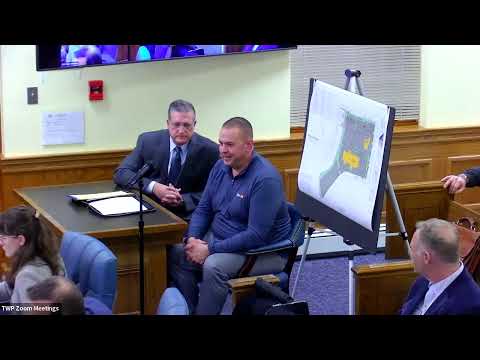
Owen Dykstra of Dykstra Associates, the applicant’s civil engineer, reviewed a colorized presentation plan showing reconstructed pavement, replaced curbing, widened transitions between the two lots, added landscaping and formalized paving of an existing gravel storage area. "We're adding 4 EV chargers at the Ford dealership" and two at the Jeep lot, Dykstra said, and described relocated ADA stalls, a new ADA ramp and crosswalks connecting the properties. He said the grading revisions will provide positive drainage and reduce existing low spots.
Board attorney Steven Warner confirmed the board had jurisdiction to consider the amended site plan and explained that because the site predates the I‑21 industrial zone, some lot‑coverage and setback deviations could be preexisting nonconformities and might not require separate variance relief. Warner summarized the board's position by noting the application could be decided as a minor site plan with the planner’s recommended conditions.
During review, board members queried whether the EV chargers would be publicly accessible (Dykstra said they would be level‑3 chargers and open for use), where pervious coverage would be added, and whether landscaping would serve stormwater functions. Dykstra said the proposed perimeter plantings were intended primarily for buffering and aesthetics though they would also help with runoff.
A board member moved to approve the amended site plan with the planner’s stipulations; the motion was seconded. The clerk recorded the roll call: Flowers, Nunn, Rabbit, Barrett, Benoit, Cohen, Greglia and Bai voted yes; Lasso was absent. The motion carried.
The approval clears the way for the applicant to proceed with construction under the spelled‑out conditions; the board did not require additional variance process for the discussed nonconformities but indicated cleanup relief could be considered if necessary. The planning board adjourned the meeting after routine business and no additional public comment.