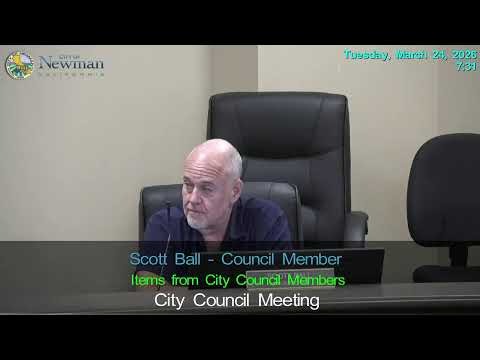
Newman City Council adopts Road Safety Action Plan to target high-injury corridors
Loading...
Summary
On March 24, 2026 the Newman City Council unanimously adopted a Road Safety Action Plan that targets 12 priority locations and recommends a mix of site-specific projects, systemic street treatments and education programs aimed at cutting fatal and serious-injury crashes.
The Newman City Council on March 24 voted 5-0 to adopt a Road Safety Action Plan that city staff and consultants say is designed to reduce fatal and serious-injury crashes by focusing on the city’s highest-risk corridors and intersections.
The plan, presented by Kyle McGowan of Tool Design Group, uses crash data from 2015–2024 and community input to identify 12 priority locations and a set of systemic and non‑infrastructure strategies. "It’s a data- and community-informed road map to reduce crashes in Newman," McGowan said during the council meeting.
McGowan told the council the team analyzed a decade of crash records and identified 116 crashes during the study period, nine of which resulted in fatal or serious injuries; two involved pedestrians, three involved bicyclists and four involved motor vehicles. The consultant said the top contributing factors were speeding, right-of-way violations and driving under the influence, and that about one-quarter of crashes occurred in dark conditions — a finding the presentation said points to opportunities for improved lighting.
The plan groups recommended improvements into location-specific projects, systemic street treatments and non-infrastructure measures. Location-specific fixes include high-visibility crosswalks, speed-feedback signs, bike lanes, flashing stop-sign beacons, ADA-compliant curb ramps and curb extensions at prioritized intersections. Systemic changes proposed for repeat problem corridors include lane-striping to narrow travel lanes and the use of rectangular rapid flashing beacons. Non-infrastructure proposals include school-based safety curricula, public education campaigns and a neighborhood traffic-calming toolbox residents can petition to use on local streets.
Thomas, a city staff member, told the council the project cost was approximately $150,000, funded by about $120,000 from a grant and a roughly $30,000 local match from the local transportation fund. He and McGowan emphasized that the plan also outlines funding pathways — including state and federal programs such as the Active Transportation Program, CMAQ and the federal Safe Streets and Roads for All program — that the city can pursue to implement projects.
A council member asked whether the plan’s education efforts would engage the school district; McGowan said the team recommends developing school curriculum to teach safe routes to and from school. Another question about whether numbered points on the plan’s map were ranked was answered by McGowan: the numbers identify profile pages for each location rather than an ordinal ranking.
After brief public and council discussion — including a request from a member of the public to review traffic calming near Hunt Elementary — a council member moved to adopt the resolution adopting the City of Newman Road Safety Action Plan. The motion passed 5-0. The plan calls for staff to pursue grant funding and to track safety metrics annually as projects move into design and construction.
City staff said next steps include pursuing available grants and prioritizing short-, medium- and long-term projects identified in the plan.