Senate panel backs council to pursue multi‑state clinical trials of ibogaine for PTSD and opioid disorders
Loading...
Summary
The Senate Finance Committee voted to advance a bill creating a Tennessee council to explore participation in multi‑state clinical trials of ibogaine for opioid use disorder and PTSD. Witnesses — including veterans and researchers — urged clinical research while members pressed for clarification about evidence and FDA oversight.
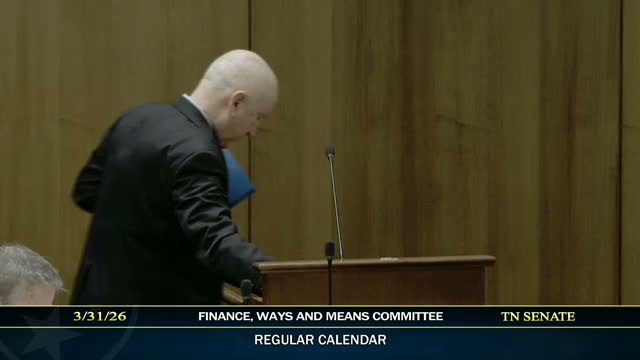
The Tennessee Senate Finance, Ways and Means Committee on March 31 recommended passage of Senate Bill 2149, which would establish a Tennessee Council on Emerging Mental Health Treatments to evaluate and potentially join a multi‑state consortium studying ibogaine as a therapy for opioid use disorder and post‑traumatic stress disorder.
Sponsor Senator Wally told the committee the bill creates a structure to let Tennessee join clinical research that could bring new treatment options for veterans and people with treatment‑resistant substance use and mental‑health disorders. "This bill is how we're gonna start," he said, adding the measure contains no state appropriation and would not legalize ibogaine or bypass the FDA.
Three witnesses spoke in support. Ricky Harris of Tennessee Voices framed the need for new approaches and asked the committee to "stand with those present and those unable to be here to pass the bill to demonstrate our collective commitment to lead the nation in solutions, not statistics." Veteran Sean Ryan described his own experience after receiving ibogaine treatment abroad and said it ended his cravings and addiction: "I haven't had a drink in over 3 years now," he testified. Jeffrey Lawrence, research director at the Reason Foundation, summarized early clinical evidence and cost estimates, saying small studies have shown high rates of abstinence and that multi‑state trials could be necessary to reach FDA standards.
Committee members pressed witnesses on the limited clinical record. Senator Sergio questioned the strength of evidence from small cohorts; Mr. Lawrence acknowledged the U.S. lacks phase‑based FDA clinical trials for ibogaine and said the bill's purpose is to enable those trials. The committee confirmed the council would be Tennessee‑based and that any research participation would require FDA approval and oversight.
The committee adopted two finance amendments that rewrite and clarify the bill's structure and permit the council to accept gifts, and then recommended SB 2149 for passage to the committee on the calendar. No state appropriation is included in the bill; sponsors and witnesses said additional public or private matching would likely be needed for larger clinical investments.
Supporters said early indicators and anecdotal veteran testimony make the research effort worth pursuing; skeptics urged caution given the small size of existing studies and that ibogaine is currently a Schedule I substance in the United States, meaning trials would proceed under investigational new drug procedures. The committee did not take separate action to appropriate funds; the bill instead creates a mechanism to participate in multi‑state clinical research once partners and funding are in place.
Status: SB 2149 as amended was recommended for passage to the committee on the calendar. The measure includes language enabling a Tennessee council to consider joining a multi‑state consortium and to accept gifts or grants to support that work.