Lifetime Citizen Portal Access — AI Briefings, Alerts & Unlimited Follows
House panel advances bills on ankle-monitoring, GPS monitoring and interlock requirements
Loading...
Summary
A legislative committee advanced a slate of public-safety bills, including adding DUI with great bodily injury as a bar to ankle monitoring, reserving GPS monitoring as a release condition for certain domestic-abuse offenses (with vendor oversight questions), and making interlock devices a bail condition for DUI defendants; a bill to forward abuse reports to the OSBI passed after debate over expungement safeguards.
A House committee advanced roughly a dozen criminal-justice and public-safety measures on a single agenda, while spending the most time on three items that raised legal and practical questions: GPS monitoring for some domestic-abuse releases, interlock-device requirements for DUI bail, and a proposal to require forwarding abuse reports to the Oklahoma State Bureau of Investigation.
The bills matter because they change pretrial and post-release monitoring rules, affect who bears device and installation costs, and alter how abuse reports are shared with state investigators — all of which have implications for victim safety, defendants' rights and agency operations.
Representative Wilk, who presented Senate Bill 137, said the measure "is removing an, or adding an ineligibility factor" to the existing ankle-monitoring program: "if you have a DUI with a GBI, you no longer qualify for the program." Members asked operational questions about who monitors ankle devices; the sponsor answered that the program is already in place and the bill only changes eligibility. The committee showed SB137 out as a do-pass.
The committee spent substantial time on Senate Bill 1325, a measure that would require GPS monitoring as a release condition for certain domestic-abuse offenses. Representative Hassenbeck, the sponsor, told members she expects technical amendments and said vendors and monitoring protocols remain unresolved: "I think there is a requirement that we've — we're gonna have to get an amendment to this before the next committee meeting." She added the state will likely need procurement work such as an RFP to clarify who provides monitoring and how it is overseen. Members pressed whether victims could track suspects and who would set geofence sizes; the sponsor said judges would set geofence distances in the court order (for example, specifying 300 feet versus miles) and that vendor capabilities would determine notification mechanics. The sponsor indicated she will bring back amendments addressing vendor oversight and implementation details.
Representative Harris presented Senate Bill 1256 to make interlock devices a condition of bail for many DUI defendants. Members questioned practical logistics and fairness: Representative Clinton asked how soon defendants must install an interlock after being released and whether people who are later found not guilty could be left to cover substantial installation fees. Committee members noted courts commonly give a short window — days to a week — for a defendant to report to an interlock installer; if the condition is not met, a judge can revoke bail. Representative Harden asked whether owners of multiple vehicles must install devices on every car; responses from the chair and sponsor emphasized the device needs to be on the vehicle the person drives and that courts and judges retain discretion. The committee recorded SB1256 as a do-pass.
A more contested vote came on Senate Bill 1730, which would require law enforcement agencies to forward certain abuse reports to the Oklahoma State Bureau of Investigation (OSBI) so repeat offenders can be identified. Representative Manger, the sponsor, said the change aims to help identify offenders who move between jurisdictions. Representative Clinton and others repeatedly raised the risk that someone falsely accused could be listed in an investigatory database; "either being falsely accused or those accusations not being fully adjudicated out and then they're on some sort of registry afterwards" was a central concern voiced by Representative Clinton. The sponsor responded that entries could be expunged following existing OSBI procedures: "it could be expunged just as any other could with OSBI," he said, and noted many agencies already forward similar reports. The committee approved SB1730; the tally was recorded in committee as 4 ayes and 2 nays.
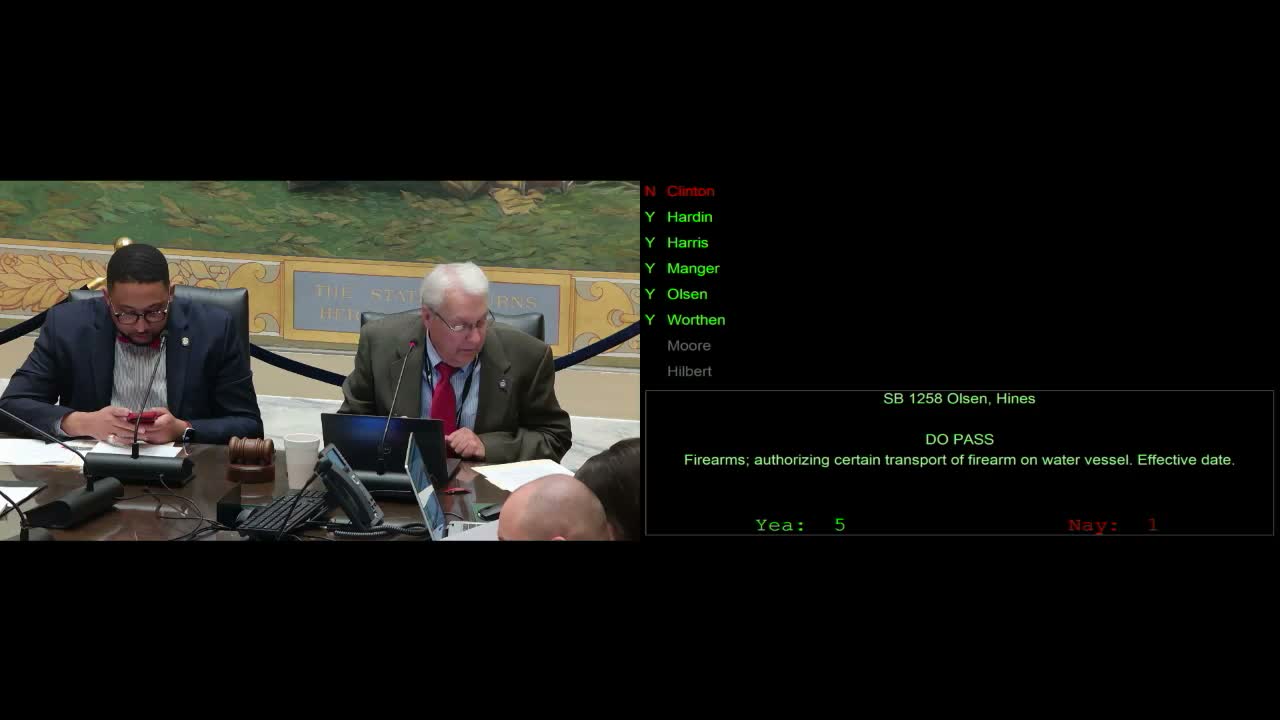
Votes at a glance: SB137 (ankle-monitoring ineligibility) — do pass; SB1255 (medical director authority for pardon/parole assessments) — do pass; SB1226 (remain-at-scene expansion to property damage, $500 misdemeanor fine mentioned) — do pass; SB1238 (domestic-assault charging modifications) — do pass; SB1258 (carry on vessel/constitutional-carry clarification) — do pass; SB1325 (GPS monitoring for certain domestic abusers) — shown as do pass with sponsor to return with amendments; SB1460 (repeat peeping/recording penalties) — do pass; SB1548 (aggregate multiple DUIs into a single felony prosecution) — do pass; SB1730 (forward abuse reports to OSBI) — approved (committee tally 4–2); SB1921 (raise OSBI fees) — approved (tally reported as 6 ayes); SB1733 (school reporting modifications) — do pass; SB1216 (drug-court eligibility changes) — do pass; SB1256 (interlock condition of bail) — do pass.
Committee members asked for clarifying language on several bills and the sponsors acknowledged forthcoming amendments or follow-up work: who operates or monitors GPS and ankle devices, procurement and vendor oversight (including an RFP), geofence parameters to be set by judicial order, and protections/expungement pathways for people found not guilty. Representative Geiss offered a moment of personal privilege while presenting SB1548, citing family impacted by repeat DUI.
The chair said the panel will reconvene next Tuesday to consider about a dozen to 15 more bills, and he expected to post the list by Thursday. The meeting adjourned.