Maine House advances study on climate damages, sending 'climate superfund' accounting to the Senate
Loading...
Summary
After a lengthy floor debate, the Maine House voted to advance a majority report directing the Department of Environmental Protection to conduct a statewide accounting of climate damages (covering the 1995–2024 period) and to deliver a report by January 2028; lawmakers clashed over legal risks, scope and a $600,000 appropriation.
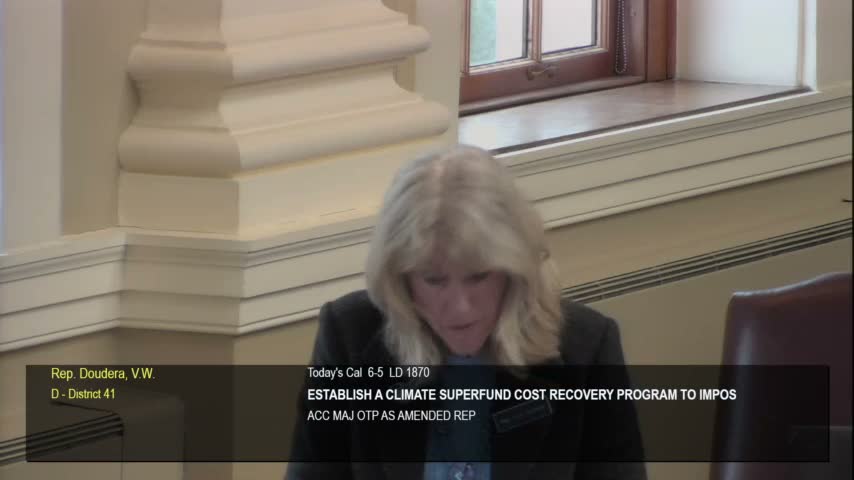
The Maine House of Representatives on April 1 advanced a majority report for LD 18 70 directing the Department of Environmental Protection to conduct an accounting of the cost of climate damages and to report back to the Legislature, a step proponents said is necessary to hold large polluters accountable.
Representative Dudera, speaking in support, said the measure "directs the state to assess the cost of climate damage to our state, including costs incurred to agriculture, economy, infrastructure and natural resources," and framed the study as the first step toward recouping funds for rebuilding and resilience. Supporters argued that recent storms and infrastructure damage demonstrate the scale of costs borne by Maine taxpayers and municipalities.
Opponents warned the study and its procedural setup could invite litigation and federal entanglement. Representative Sobolewski argued the amendment adopted by the committee effectively transforms the bill into a multi-year study, with a $600,000 appropriation, and "sets the stage for the next legislature" while creating a politically and legally charged accounting that could be used in future suits. He and other critics said similar measures in other states have triggered federal litigation and Department of Justice involvement.
Other lawmakers pressed practical and technical details about the assessment period and deadlines. The majority report directs DEP to analyze emissions and climate costs for the period identified in the committee report (as discussed on the floor, members referenced coverage beginning in 1995 through 2024) and noted a delivery date for the resulting accounting in January 2028. Representative Ocher described the accounting as "the first critical step toward holding climate polluters accountable" and said legislators need the fiscal accounting before considering recovery or regulatory steps.
Debate included questions about the methodology, how damages would be tallied and whether the report would create evidentiary materials that could be used in litigation. Representative Riley, another supporter, said the study would allow Maine to "identify the true cost that oil companies will cause to Maine's taxpayers" and argued communities should not continue to shoulder those costs alone.
After extended debate and several roll-call requests, the House moved the majority report as amended and ordered it sent to the Senate for concurrence (the clerk announced the motion as having "been grossed in concurrence"). The floor record as read during the session reports the roll-call counts for the final movement of the measure; the transcript record includes a reported affirmative/negative reading as recorded on the floor.
What happens next: The report, if produced according to the majority recommendation, is intended to inform future legislative options including possible cost-recovery measures. The House record shows the measure was ordered sent to the Senate for concurrence.