Get Full Government Meeting Transcripts, Videos, & Alerts Forever!
Get email alerts on the Housing Zoning topic
No spam. Unsubscribe anytime.
Council adopts housing-element resolution and two inclusionary overlay ordinances after public hearing; neighbors raise traffic, parking and cannabis retailconc
Summary
Council endorsed the housing element/fair-share plan and adopted two zoning overlay ordinances after public comment highlighting traffic, parking and compatibility concerns—council and staff said project-specific site plans and traffic studies will follow.
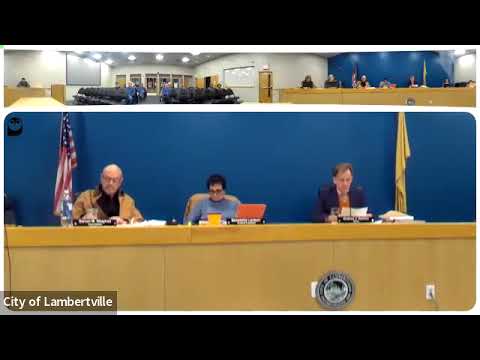
The Lambertville City Council voted to endorse the housing element and fair-share plan and adopted two zoning overlay ordinances after a public hearing in which nearby residents urged caution about traffic and compatibility with existing commercial uses.
Council first approved Resolution 66-2026 to endorse the housing element and fair-share plan; Mayor Christina Deal thanked staff and volunteers for producing the plan and said endorsing the plan signals the city’s commitment to addressing affordability. Council recorded a voice vote in which members signaled 'aye' to adopt the resolution.
The council then opened the public hearing on Ordinance 01-2026, an inclusionary overlay intended to allow optional inclusionary development on several blocks (Block 1006, lots listed during the hearing). Residents who spoke supported more affordable housing in principle but raised practical concerns. Lauren Brons Ravel (S4) said the proposed overlay includes properties near her home and asked for clarification about changes to vehicular and pedestrian access. Carol Hoekje (S5) supported increased affordable housing but said the presence of a cannabis retail store on the same site generated nonstop vehicle and foot traffic and worried that the current driveway and Elm Street entrance are too narrow for the two-way vehicle circulation described in the proposal.
Council members and staff responded that the ordinance creates an optional development pathway and that any specific project will require site plans, traffic and circulation studies, and additional public hearings through planning-board review. They also noted the redevelopment process for the high-school site is already the subject of court filings and that the city is negotiating a redevelopment agreement; the mayor emphasized the city’s three main redevelopment priorities are environmental conditions at the site, stormwater management, and traffic and pedestrian circulation.
Following the hearing, the council moved and seconded adoption of Ordinance 01-2026 on second reading; members voted unanimously 'aye' to grant final approval. Council also adopted Ordinance 02-2026 on second reading, an optional generic housing overlay intended to increase the city’s capacity to meet fair-share housing obligations. Planning Board recommendations to include a table of bulk, yard and height information were noted; council members said that amendment could be considered later if necessary.
Council members emphasized that the overlay zones do not by themselves authorize construction; rather, they create an optional regulatory framework that developers may use, subject to normal site-plan review and additional public hearings. Residents who spoke asked the city to provide clearer maps showing where new access points would be located and to assure parking and traffic mitigation would be required at project review.