Get Full Government Meeting Transcripts, Videos, & Alerts Forever!
Get email alerts on the Housing Policy topic
No spam. Unsubscribe anytime.
Nonprofit presenters explain Illinois source-of-income protections, local intake trends and how tenants can respond
Summary
Presenters from Hope Fair Housing Center, Housing Action Illinois and Prairie State Legal Services explained the 2022 Illinois source-of-income law (implemented 2023), shared local DeKalb intake data and offered practical remedies and sample demand letters for tenants experiencing discrimination.
Jocelyn Rios, education outreach director at Hope Fair Housing Center, and partners outlined new state protections against source-of-income discrimination on a DeKalb training session and urged tenants who face refusals because of vouchers, emergency rental assistance or other nonwage income to document incidents and seek help.
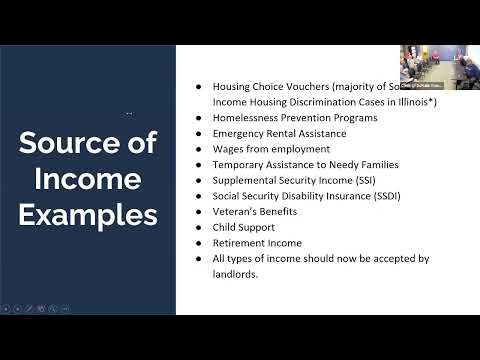
The presentation, led by Housing Action Illinois with legal partner Prairie State Legal Services and Hope Fair Housing Center, explained that the Illinois Human Rights Act now bars landlords and agents from denying housing solely because a tenantor applicantuses a legal source of income such as Social Security benefits, veterans benefits, child support, emergency rental assistance or housing choice vouchers. The presenters described enforcement options through the U.S. Department of Housing and Urban Development, the Illinois Department of Human Rights (IDHR) and, in some places, local human-rights ordinances such as Cook Countyand Chicagorules.
Why it matters: Presenters said source-of-income barriers remain a common practical obstacle to housing stability and, when enforced against voucher holders, tend to reinforce racial and economic segregation in opportunity-rich neighborhoods. "You can't say 'we don't take Section 8,'" Rios said; that sort of blanket refusal can be unlawful under the state law and related guidance.
What presenters told landlords and tenants
- Definitions and examples: The speakers defined source-of-income discrimination as different terms, conditions or services imposed because of how a person pays or expects to pay rent. Examples named during the session included false "no availability" statements, steering voucher holders away from amenity-rich listings, charging voucher holders extra application fees or insisting on side payments.
- How minimum-income policies apply: The presenters explained that when a tenant uses a voucher, a housing provider must evaluate the landlordor tenantportion correctly. A minimum-income screen that purports to apply to the full rent must instead be applied to the tenant portion after voucher calculations, not to the voucher payment itself.
- Reasonable accommodations and animals: Presenters emphasized that reasonable-accommodation requests tied to a disability cannot be denied or charged an additional security deposit; documentation from a medical or therapeutic professional is commonly used to verify the need, and landlords may verify the issuing clinician where fraud is suspected.
Local intake numbers and enforcement choices
Rios said Hope's intake line logged 203 source-of-income-related intakes from January 2023 through August 2025. In DeKalb specifically the group has received 7 source-of-income intakes in the city and 9 in DeKalb County, and the organization recorded 32 fair-housing intakes in the broader DeKalb service area. Rios urged tenants to keep written records (emails, text messages, advertisements) and to try an initial self-advocacy letter asking a housing provider to reconsider, because informal resolutions are often quicker than formal IDHR or HUD complaints.
Litigation examples and testing
Rios described two ongoing legal matters that Hope helped bring forward: a federal class-action against MAC Properties and a state-court suit against Fulton Grace Realty. Hopeand partnering organizations used trained fair-housing testers to document patterns: testers with comparable budgets and different voucher statuses received systematically different treatment, the presenters said. "Testing revealed a pattern" of voucher holders being told units were unavailable or being routed to older, less desirable units, Rios said.
Legal timelines and remedies
Presenters reminded attendees of statute-of-limitations windows: administrative complaints with HUD or IDHR are generally brought within one year of the last incident, while litigation in state or federal court typically uses a two-year window. Hope described an intake workflow that begins with an intake specialist and may proceed to informal resolution or a formal complaint; Prairie State Legal Services advised tenants that legal representation is available for eligible clients.
How to get help and next steps
Hope and partners offered a downloadable "source-of-income toolkit" containing sample demand letters (general discrimination and minimum-income-policy templates), guidance text from IDHR and suggested documentation checklists. Rios said the organizations will assist with technical questions for both tenants and property owners and encouraged affected people to contact Hope or Prairie State for case review.
Representative quotes from the session include Rios: "We have received a total of 203 source-of-income-related intakes," and Carlos of Prairie State Legal Services: "We'll fight for you, and we'll do it for free," describing the firm's representation of tenants in discrimination cases. The session closed with presenters posting slide resources and a request that attendees complete an evaluation.
The organizations did not announce new local enforcement actions during the session; they urged individuals who believe they were denied housing because of a protected income source to preserve records, consider the sample letter and contact one of the nonprofits for intake assistance.