Iowa House passes English-proficiency requirement for commercial drivers after heated debate over enforcement and penalties
Loading...
Summary
The House passed a bill requiring commercial driver license applicants and renewals to demonstrate English proficiency and authorizing fines and out-of-service orders; members debated enforcement, fiscal costs and whether carriers or drivers should bear greater penalties.
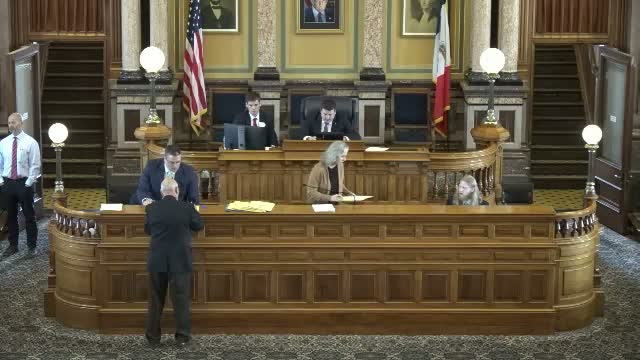
The Iowa House on the floor passed Senate File 2426 after extended debate and amendment, adopting requirements that people applying for or renewing commercial driver licenses must demonstrate sufficient English-language proficiency to converse with the public, read highway signs and answer official inquiries.
Representative Tom Meyer, the bill sponsor, said the measure fills an enforcement gap and ‘‘makes Iowa roads safe for Iowans’’ by enabling officers to impose out-of-service orders and by increasing monetary penalties for carriers that employ drivers who are not proficient. ‘‘We have increased the monetary penalties... Dollars 10,000 for each offense. Out of service means they cannot operate. Anywhere,’’ Meyer said in closing remarks.
Opponents and questioners pressed the sponsors on whether the policy duplicates a federal requirement and on implementation costs. Representative Wilson pointed to federal regulation 49 CFR 391.11(b)(2), asked why the state would add another test and emphasized reports to the committee that some drivers were victims of trafficking and that some carriers exploit non‑English‑proficient workers. ‘‘Some of these people were being trafficked… smaller carriers [are] coming in and exploiting these individuals,’’ Wilson said, arguing carriers should face strong penalties.
Meyer responded that federal enforcement was inconsistent: according to Meyer, enforcement paused in 2016 and was reinforced last summer, and Iowa officers had placed roughly 500 drivers out of service since June 2025. He said the bill responds to a practical enforcement problem—drivers sometimes resumed driving after officers left—and that the bill targets both drivers and carriers by combining penalties and out‑of‑service authority.
Members also discussed the bill’s fiscal note and the cost to implement an English‑proficiency exam. Representative Wilson noted the fiscal estimate of about $74,000 to stand up testing; Meyer said the Department of Transportation can absorb the cost within DOT funding.
The House adopted several amendments during floor consideration, including a secondary amendment that sponsors described as increasing monetary penalties on carriers while adjusting certain misdemeanor classifications to improve enforceability against out‑of‑state carriers. One floor amendment (H8273) was adopted by a recorded vote of 62–28; the final passage vote on the bill was recorded as 68–24 with eight members absent or not voting.
The bill text makes first responders’ ability to issue out‑of‑service orders part of the enforcement toolkit, applies civil penalties and includes misdemeanor penalties as specified in the bill language. The bill now moves to the Iowa Senate for consideration.