Applicant asks for more time after Metro prompts staff to relocate proposed shared-use path on Molalla Avenue master plan
Loading...
Summary
At a March 23 Oregon City Planning Commission hearing, staff recommended relocating a proposed shared-use path to integrate with a future apartment parcel; the applicant, Cypress Equities, said a late Metro comment prompted the change and requested a two‑week continuance. Neighbors and Metro raised safety, privacy and stormwater concerns.
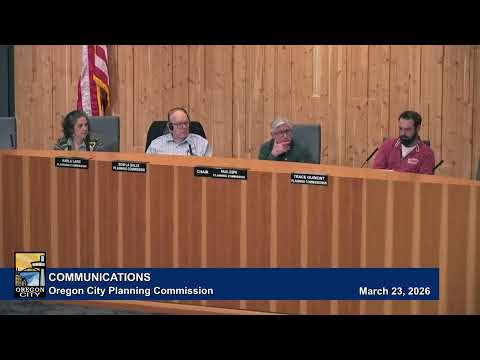
Chair Espy opened a quasi-judicial public hearing March 23 on a 20‑year master plan and detailed development plan (GLUA 2500025) for redevelopment at 1367 Molalla Avenue that would add a new public road and enable mixed commercial uses, two drive‑through facilities and a future apartment parcel.
Staff planner Christina summarized the application and related staff reports, saying the city received ODOT input requiring proportional contributions to a right‑turn slip lane at OR‑213/Beavercreek, Metro comments about a shared‑use path alignment, and several recent public comments entered into the record. Staff recommended approval with revised conditions, including enhanced landscaping at Molalla Avenue and a revised condition that would require the applicant to relocate the planned paved shared‑use bike/ped path higher on the site so it would be integrated with the apartment parcel and more visible to users.
The relocation recommendation reflects the city’s geologic‑hazard and natural‑resource overlay review: staff said the originally proposed lower alignment would encroach on a 50‑foot buffer and, while the path could be built as conditioned, visibility and safety concerns motivated a condition to integrate the path with Parcel B’s development. Staff also described mitigation options (on‑site or within the same basin) and the city’s stormwater standard that runoff must be released at predevelopment rates back into the originating basin.
Applicant counsel Greg Hathaway said Cypress Equities largely agrees with staff’s conditions but was surprised to learn late—after a Metro letter arrived—that staff now recommends relocating the shared‑use path. Hathaway said that relocation could materially alter the project’s design and raise questions about the city’s authority to require certain off‑site path improvements. He formally requested a two‑week continuance to coordinate with Metro and staff and to assess feasibility.
Neighbors who live near the proposed Hilltop Avenue connection testified that the path raises privacy and safety concerns, including light trespass, increased foot traffic where sidewalks are absent, and preexisting issues with homeless encampments and debris. Metro attorney Gary Shepherd said Metro received short notice of the hearing, voiced similar concerns about path location and easement access, and asked to be part of follow‑up discussions. Transportation reviewer Mike Ard (Ard Engineering) told the commission he believes the applicant’s trip distribution understates traffic through the Warner Milne/Lynn intersection and urged further analysis of nearby intersections and drive‑through trip rates.
Commissioners raised additional questions about the parking‑maximum adjustment on Parcels A and D (staff framed the request as site‑planning mitigation tied to a no‑build easement and gateway landscaping), tree heights near power lines, lighting and signage controls, and measures to limit construction dust and erosion. After deliberation, the commission voted to continue GLUA 2500025 to the April 13, 2026 planning commission meeting to give the applicant and Metro time to meet and to provide additional information to the record.
The continuance means staff and the applicant will have a limited period to negotiate the precise shared‑path location, confirm mitigation and easement arrangements with Metro and adjacent property owners, and update traffic or geotechnical responses before the commission resumes the quasi‑judicial review.