Oak Ridge National Laboratory researcher outlines OPAL automation effort to accelerate multiscale biology
Loading...
Summary
John Lagergan of Oak Ridge National Laboratory described OPAL, a Department of Energy cross‑laboratory program that uses automation and AI to coordinate work on proteins, microbes and plants to tackle grand challenges such as extracting critical minerals from soil.
John Lagergan, an R&D researcher in the Biosciences Division at Oak Ridge National Laboratory, described OPAL as “this cross laboratory project to solve multiscale problems in biology through laboratory automation.”
Lagergan said OPAL brings four national laboratories together to combine engineering of proteins and microbes with automated plant experiments to accelerate discovery. “We are trying to optimize not only proteins and microbes, but also plants in combination with those,” he said, citing work aimed at problems such as critical‑mineral uptake.
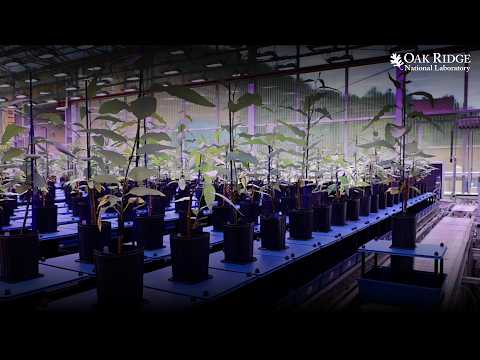
According to Lagergan, the collaboration assigns specific roles across participating labs: Argonne National Laboratory is focused on protein and enzyme engineering; Pacific Northwest National Laboratory and Lawrence Berkeley National Laboratory are working on engineering microbes that will produce designed proteins; and Oak Ridge will grow engineered plants in APPLE, the Advanced Plant Phenotyping Laboratory. “Those will go into the soils, plants that we grow here in APPLE at Oak Ridge while also genetically engineering better plants so that the toxic metals and other substances don't kill them,” he said.
Lagergan described APPLE as a robotic facility that “generates tons of multimodal image data of plants under various conditions over time.” He also pointed to Frontier as a capability to train new foundational AI models to scale experiments and predict plant phenotypes and traits: “We can train brand new state of the art foundational AI models to predict…design better experiments for the next iteration.”
Lagergan placed OPAL inside the Department of Energy’s Genesis mission, calling OPAL a subcomponent that uses AI and laboratory automation to address grand challenges in critical minerals, materials and biotechnology. He said the goal is both to scale experiments and to make them more targeted and informative so discoveries happen faster.
The interview did not specify funding amounts, timelines or formal milestones for OPAL. Lagergan’s remarks primarily explained the program’s technical approach and the roles of participating laboratories; no formal announcements of specific near‑term actions or decisions were made during the conversation.