Get Full Government Meeting Transcripts, Videos, & Alerts Forever!
Get email alerts on the Public Safety topic
No spam. Unsubscribe anytime.
Cerritos safety committee credits ALPR cameras as burglaries fall, highlights faster response times
Summary
At its March 18 meeting the Cerritos Community Safety Committee heard from Captain Drew Strong and Deputy Neil Wendland, who reported a 43% drop in residential burglaries, a 26% decline in Part 1 crimes overall, successful ALPR hits that led to arrests and improvements in response times; the committee received and filed the report.
The Cerritos Community Safety Committee on March 18 received an informational briefing from Captain Drew Strong and Deputy Neil Wendland on crime and traffic trends across the city. Captain Strong said Part 1 crimes are down 26% year to date, residential burglaries have decreased about 43% (from 46 to 26), and homicides are at zero so far this year compared with two last year.
“The ALPR cameras have been installed, and they are yielding results already,” Captain Drew Strong said, describing a March 13 incident in which an automated license-plate-recognition hit led deputies to a stopped vehicle where they recovered a stolen firearm, drug paraphernalia and ammunition and arrested a driver who is a convicted felon. He credited a mix of targeted patrols, special-assignment deputies and technology for part of the improvement.
The presenters gave more granular figures: shoplifting/robbery incidents rose by one (a 33.3% increase from three to four), thefts over $950 decreased about 10%, and petty thefts fell roughly 42%. Captain Strong said aggravated assaults have spiked in some locations, including mall and town-center parking lots, and urged continued monitoring and additional patrols in those areas.
Officials described operational changes that aimed to shorten response times for high-priority audible burglaries: the department reclassified certain alarm calls from routine to priority, reducing the average response time on priority burglary calls to about 7.76 minutes (from an earlier average on similar calls of roughly 26 minutes). Emergent responses were reported at about three minutes.
A resident who said their home was burglarized despite having lights, cameras and an alarm asked what steps follow fingerprint collection. Captain Strong said cases are prioritized based on “workable information” — for example, suspect descriptions, vehicle descriptions or license plates — and investigators use ALPR data and, when available, camera images to put pieces of a case together. “Every case is a priority, but we do prioritize based on workable information,” he said.
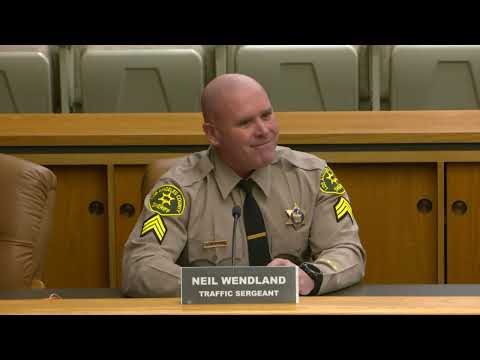
Deputy Neil Wendland briefed the committee on traffic, saying collisions increased slightly (about 10 more compared with last year) and naming Gridley and South as recurring locations. He cited common causes such as speeding, failure to yield and unsafe turning movements and said private-property areas such as the mall and town center have higher numbers of hit-and-runs; he reported a hit-and-run in Norwalk/Del Amo where a suspect was located and the case will be filed with the district attorney.
City staff and presenters noted the council dedicated nearly $700,000 toward ALPR camera deployment, and phase 3 of the camera rollout was completed roughly two weeks before the meeting, leaving “about 50–55 cameras” operational at strategic intersections and near high-traffic areas including Cerritos Town Center and the neighborhood around Studebaker/166 near Cerritos College. The committee and staff described the system and funding as a partnership among council, staff and residents.
Committee members raised related concerns — fence cuts and recurring encampments near a reservoir park, school lockdowns prompted by automated or mass calls, and enforcement strategies — and staff said city crews handle repairs to city property while sheriff’s staff will continue outreach and coordinate with state teams as needed. On school lockdowns, Captain Strong said many of the mass calls appear to be computer-generated and that the department treats each threat seriously but currently has no evidence that students are orchestrating the calls to miss tests.
Procedurally, the committee moved to receive and file the report; the motion was seconded and passed by voice vote. Earlier routine actions at the meeting included excusing two members and approving the consent calendar.
The committee did not take any new policy votes on patrol staffing or camera procurement at the meeting; staff offered to follow up offline on neighborhood-watch enrollment numbers and other details.